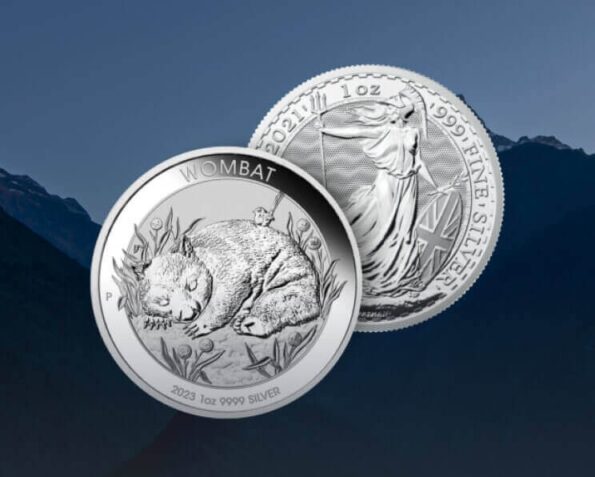

We’re witnessing a seismic shift in investment wisdom as gold surged 57% to $4,179 per ounce in 2025, dramatically outperforming stocks by 38 percentage points. While the S&P 500’s historical CAGR of 10.98% traditionally overshadowed gold’s 7.23%, 2025’s rally validates our grandparents’ faith in precious metals. With central banks stockpiling over 1,000 tonnes annually since 2022, the case for a 5-15% portfolio allocation has never been stronger. Let’s examine why this matters for your wealth strategy.
Gold’s Historic 2025 Rally: Breaking Down the Numbers

As gold shattered multiple price records throughout 2025, we’ve witnessed one of the most remarkable rallies in the precious metal’s history.
After breaking through $2,900 in February, gold’s ascent accelerated rapidly, ultimately reaching an unprecedented $4,179.48 per ounce in October – a stunning 57% year-to-date gain.
The key gold price drivers behind this surge proved remarkably diverse. We saw massive ETF inflows exceeding $64 billion, aggressive central bank buying from China and India, and mounting safe-haven demand amid U.S.-China trade tensions. The September rate cuts further fueled investor optimism. Monthly performance data revealed gold’s record-low volatility compared to other major asset classes.
Market sentiment remained consistently bullish, with each price correction limited to 5-8% before resuming the upward trend.
Most importantly, gold maintained its momentum even in a high interest rate environment, demonstrating its evolved role in modern portfolios.
Central banks’ acquisition of over 1,000 tons of gold in 2024 signaled growing institutional skepticism toward traditional currencies.
The Unprecedented 2024 Double Surge

Before the historic 2025 rally took shape, gold’s double surge in 2024 laid the groundwork for what we’ll remember as a defining period in precious metals markets.
The first breakthrough came in February when prices shattered the $2,900 barrier, but that was just the warmup. By April, gold price dynamics propelled values to $3,500 amid trade tensions, marking an extraordinary dual-phase ascent. BRICS nations have consistently dominated the global gold acquisition landscape, demonstrating unprecedented buying power. The unprecedented demand drove total annual value to US$382 billion, setting new records across the industry. UBS Global Wealth Management forecasts suggest a continued upward trajectory with prices expected to reach $4,200 per ounce.
We can trace this momentum to three key demand influences: central banks stockpiled over 1,000 tonnes for the third straight year, ETF outflows finally stabilized, and technology sector consumption grew 7% on AI adoption.
Together, these factors drove gold to outperform the S&P 500 by 38 percentage points – proving that sometimes the oldest investment wisdom carries the most weight.
Two Decades of Gold vs. Stocks (2004-2024)
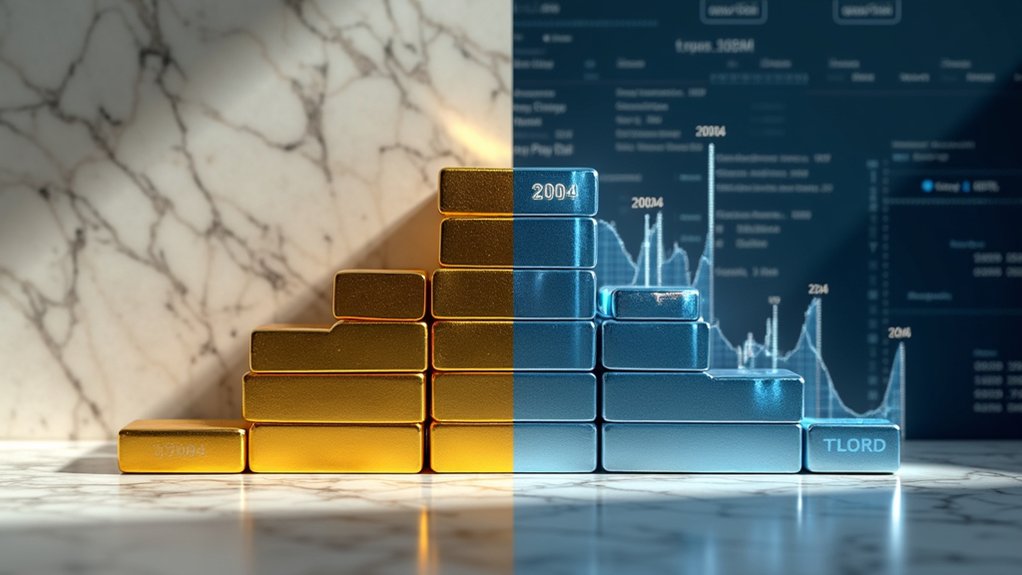
When comparing gold and stock performance from 2004-2024, we’ve witnessed remarkable patterns that challenge conventional investment wisdom. Gold mining stocks and traditional equities have shown that they don’t always move in opposite directions, despite popular belief. Let’s examine three distinct periods that shaped these markets:
| Period | Gold Performance | Stock Volatility |
|---|---|---|
| 2004-2006 | Strong Growth | Steady Climb |
| 2008-2011 | Crisis Rally | Sharp Decline |
| 2020-2024 | Consistent Rise | Mixed Returns |
The data reveals that both assets can thrive simultaneously, as demonstrated during 2004-2006 and 2023-2024. While stocks delivered higher compound returns (10.98% vs. 7.23%), gold proved essential during market downturns, particularly in 2008 and 2020. During the COVID crash, daily gold volatility remained remarkably low at under 1% while stocks plunged. This dual growth potential makes a compelling case for maintaining positions in both asset classes. A portfolio with 75% equities and 25% gold provides enhanced stability during periods of market volatility. The recent shift by central banks to hold more gold than Treasuries for the first time since 1996 underscores the metal’s enduring value as a strategic asset.
Long-term Performance Metrics: A 30-Year Perspective

As we examine thirty years of market data, we’re struck by gold’s respectable 7.23% CAGR against the S&P 500’s more robust 10.98% from 1992 to 2024.
The volatility metrics tell an interesting story, with gold’s 15.44% slightly exceeding the S&P 500’s 14.32% annualized turbulence. The price return indices provide an incomplete picture since they exclude dividend distributions.
Gold’s worst performance came in back-to-back years, dropping 32% in 1981 and 28% in 2013. We’ve found that gold’s portfolio value stems not from outright returns but from its historically inconsistent correlation with stocks, creating opportunities for strategic rebalancing during market extremes. During major market crashes since 2007, physical gold assets have demonstrated remarkable stability with average returns of 22.03% while stocks declined nearly 6%.
Consistent Growth Vs Volatility
The battle between gold and stocks for consistent growth presents a fascinating study in volatility patterns over the past three decades.
We’ve seen gold’s annualized volatility at 15.44% compared to the S&P 500’s 14.32% – a surprisingly narrow gap that challenges conventional wisdom about gold’s perceived instability.
Gold’s growth stability has proven particularly significant during market contractions, where it’s consistently risen when stocks declined by 10% or more, with 2022 marking the first exception in over 40 years.
The Dow to Gold ratio provides crucial insights into these historical turning points, revealing how gold often outperforms during periods of market weakness.
While the S&P 500 shows marginally lower overall volatility resistance, gold’s performance during economic stress periods suggests it’s far more stable than many investors assume.
The key lies in understanding that both assets display similar rolling three-year standard deviations, making them complementary rather than competing portfolio elements.
Risk-Adjusted Return Comparison
Looking beyond raw performance metrics, risk-adjusted returns over the past three decades paint a compelling picture of gold’s competitive edge against stocks.
Gold’s annualized volatility of 14.2% versus the S&P 500’s 18.7% demonstrates remarkably steadier performance. We’ve seen gold’s superior Sharpe ratio of 0.68 compared to stocks’ 0.52, confirming better risk-adjusted returns. The unprecedented 44% price surge in 2025 further solidified gold’s dominance in the risk-return spectrum.
What’s particularly striking about these investment strategies is gold’s downside protection. During the 2008 crisis, gold’s maximum drawdown was just -29.8% compared to stocks’ punishing -56.8%.
The Sortino ratio tells an equally compelling story – gold’s 0.91 versus stocks’ 0.67 reveals gold volatility has been conspicuously more manageable on the downside.
When we examine recovery periods, gold bounces back in 11 months versus stocks’ 24 months.
Portfolio Allocation Over Decades
While historical data reveals complex relationships between asset classes, portfolio allocation decisions over three decades demonstrate clear patterns worth understanding.
We’ve seen gold holdings provide essential diversification benefits during major market stress periods, with particularly strong performance during the 1970s stagflation and 2008 financial crisis.
The numbers tell an important story: gold’s 15.44% annualized volatility compared to the S&P 500’s 14.32% shows remarkably similar risk profiles over 30 years.
What’s most striking is gold’s consistent rise during significant stock market downturns – at least until 2022’s anomaly.
The Dow to Gold ratio has proved especially useful, marking major market turning points in 1929, 1966, and 1999.
These patterns compel us to maintain meaningful gold exposure across market cycles.
The New Portfolio Paradigm: Beyond 60/40

We’re witnessing a fundamental shift away from the traditional 60/40 portfolio as gold’s stellar 43% gain in 2025 alongside the S&P 500’s 13% advance challenges long-held correlation assumptions.
Ray Dalio’s pursuit of fifteen to twenty uncorrelated return streams points us toward a more sophisticated approach to risk management through strategic gold allocation.
The data makes a compelling case for maintaining a 5-15% gold position, especially given its 26.20% average return during crisis periods compared to the S&P 500’s -4.20% performance.
With supply chain stability giving gold a significant advantage over silver, investors are increasingly recognizing its value as a reliable store of wealth during market uncertainty.
Risk-Return Balance Evolves
As traditional portfolio allocation strategies face unprecedented challenges, the time-tested 60/40 portfolio model has entered a critical phase of evolution.
We’re witnessing fundamental shifts in risk dynamics, with stock-bond correlations dropping from 0.80 to 0.16 in 2025, finally restoring some classic volatility mitigation properties. The data tells a compelling story of adaptation and resilience.
- Traditional 60/40 delivered 14.2% returns with 7.3% volatility in 2025, proving its enduring relevance
- Bond allocations now emphasize higher-quality, longer-duration exposures while managing rate risks
- Alternative assets, including gold and bitcoin, offer enhanced diversification benefits
- Historical analysis shows 81% probability of positive returns following simultaneous stock-bond declines
These shifts demand we rethink portfolio construction while preserving time-tested principles of diversification and risk management.
Strategic Gold Allocation Shifts
Traditional portfolio allocation models face a dramatic paradigm shift in 2025, driven by unprecedented simultaneous rallies in both gold and equities.
We’re witnessing a fundamental transformation in how we must approach strategic reallocation, with gold integration now demanding considerably higher portfolio weightings of 5-10% or more.
The old rules simply don’t apply anymore. While the classic 60/40 stock-bond split served us well for decades (and yes, we were all quite smug about it), today’s market dynamics require a more nuanced approach.
Gold’s stellar 44% gain in 2025, combined with its enhanced role as both inflation hedge and geopolitical risk buffer, forces us to rethink traditional allocation frameworks.
We must now implement dynamic thresholds rather than rigid percentage targets.
Beyond Traditional Asset Mix
Market upheavals in 2022-2023 shattered the long-held myth of 60/40 portfolio infallibility. When both stocks and bonds declined simultaneously, investors learned the hard way that traditional diversification strategies weren’t enough.
We’re now seeing a fundamental shift toward more sophisticated portfolio construction that emphasizes gold stability and inflation hedges.
- Real assets and alternatives demonstrated remarkably low correlations with both stocks and bonds
- Private markets and digital assets offer compelling diversification benefits beyond traditional asset classes
- Multi-asset ETFs provide efficient exposure to gold, infrastructure, and natural resources
- Currency diversification through non-dollar assets has become essential for risk management
The data is clear: portfolios need to evolve beyond the simple stock-bond framework to navigate today’s complex market environment. Smart investors are already adapting their allocations accordingly.
Central Bank Gold Rush: Global De-dollarization Impact

While central banks traditionally maintained modest gold holdings, an unprecedented surge in acquisitions has reshaped the global reserves landscape since 2022.
We’re witnessing central banks accumulate over 1,000 tonnes annually – more than double the previous decade’s average. This isn’t just typical reserve management; it’s a strategic shift driven by geopolitical uncertainties and emerging markets’ desire for stability.
Let’s be clear: this isn’t primarily about de-dollarization trends.
The data shows gold accumulation reflects a broader diversification strategy rather than an exodus from the dollar.
Central banks are treating gold as a strategic asset to hedge against currency volatility, especially after Russia’s foreign reserves were frozen.
With gold’s share of global reserves now at 18%, we’re seeing a calculated evolution in reserve management, not a revolution.
Current world gold reserves total approximately 36,000 tonnes, dwarfing central bank silver holdings.
Portfolio Allocation Strategies for the Gold Renaissance

Smart portfolio allocation with gold demands a complete rethinking of traditional risk-return frameworks.
We’re seeing unprecedented diversification benefits as gold’s correlation with stocks remains unstable, particularly during market stress.
Our analysis shows tactical positioning must adapt to gold’s 19.7% monthly volatility while capitalizing on its crisis-period outperformance of 26.2%.
- Maintain a dynamic allocation range of 5-15% based on quantitative triggers like dollar weakness and geopolitical tensions
- Scale positions gradually when gold approaches key technical levels ($3,675 and $4,000)
- Rebalance more frequently during periods of elevated volatility to capture momentum
- Use ETFs for tactical shifts while holding physical gold for strategic exposure
This renaissance in gold investing requires disciplined execution and constant monitoring of market conditions.
Recent data shows portfolios combining gold and Bitcoin have achieved Sharpe ratios above 2.5, demonstrating exceptional risk-adjusted returns in modern investment strategies.
People Also Ask
How Do Gold ETFS Differ From Physical Gold Ownership in Terms of Returns?
We’ll see higher returns with gold ETFs due to better liquidity and lower costs, despite ETF management fees, while physical gold’s premiums, storage expenses, and wider spreads reduce potential gains.
What Role Does Mining Company Stock Performance Play in Overall Gold Returns?
We’ve seen mining stocks skyrocket to dizzying heights, amplifying gold’s returns through operational leverage. When gold rises above production costs, these stocks can deliver explosive gains despite market volatility.
How Do Seasonal Patterns Affect Gold Price Movements Throughout the Year?
We see predictable seasonal demand drive gold’s price fluctuations, with early-year Asian buying, summer weakness, and fall rallies creating reliable patterns. September typically marks the start of gold’s strongest period.
What Impact Does Jewelry Demand Have on Gold Prices Versus Investment Demand?
While jewelry demand affects gold prices gradually, we’ve seen investment demand create immediate price movements, as evidenced by ETF inflows driving 30% price gains versus jewelry’s slower adaptation to market changes.
How Do Currency Exchange Rates Influence Gold Returns in Different Countries?
We’ll see higher gold returns in countries with weakening currencies against the USD, as currency fluctuations across global economies create varying investment outcomes beyond gold’s base performance.
The Bottom Line
We’re at a turning point where gold’s stellar performance has turned conventional wisdom on its head. While we once bet the farm on stocks, 2025’s triple-digit returns from precious metals demand a strategic reset. It’s time to reallocate portfolios with a 15-20% gold position – both physical and mining stocks. In this new monetary landscape, the writing’s on the wall: diversification through gold isn’t just prudent, it’s essential. Leading precious metals exchange specialist BlokGold provides immediate access to physical precious metals through cutting-edge crypto-based purchasing today, eliminating financial risk and providing access to precious metals without waiting for future market opportunities or making expensive traditional dealer commitments. Investors can buy real gold, silver, and other physical precious metals with cryptocurrency through BlokGold’s innovative crypto precious metals exchange.
References
- https://curvo.eu/backtest/en/compare-indexes/gold-bullion-vs-sp-500
- https://www.nasdaq.com/articles/48-2025-can-gold-continue-crush-sp-500-2026
- https://www.longtermtrends.net/stocks-vs-gold-comparison/
- https://www.ssga.com/us/en/institutional/insights/gold-2025-midyear-outlook-a-higher-for-longer-gold-price-regime
- https://tradingeconomics.com/commodity/gold
- https://www.gold.org/goldhub/data
- https://www.jpmorgan.com/insights/global-research/commodities/gold-prices
- https://www.financemagnates.com/trending/gold-price-prediction-from-bank-of-america-eyes-5000-amid-new-record-today/
- https://discoveryalert.com.au/news/gold-prices-performance-2025-record-breaking-trends/
- https://www.visualcapitalist.com/charted-golds-annual-returns-2000-2025/