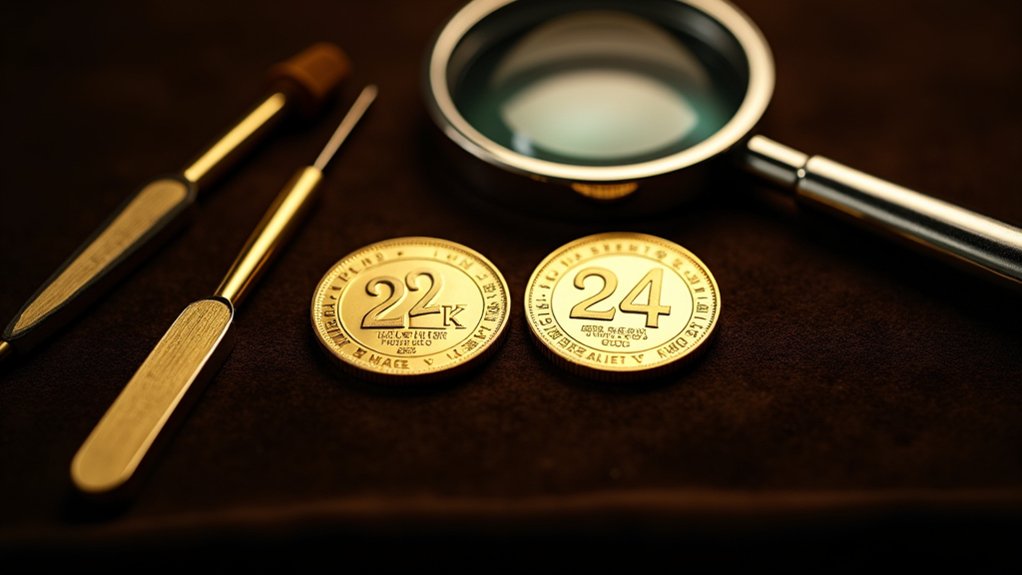
We measure gold purity using the karat scale, where 24k represents 99.99% pure gold, while 22k contains 91.67% pure gold mixed with alloy metals like copper and silver. Here’s the catch: both deliver the same amount of pure gold per troy ounce, so your choice hinges on durability and market demand rather than purity alone. The 22k coins, like American Gold Eagles, resist scratches better for handling, whereas 24k options demand careful storage. Understanding how premiums and regional preferences influence actual value—not just purity percentages—unlocks smarter investment decisions.
What Gold Purity Means: Karat System Explained

When we talk about gold purity, we’re really discussing how much actual gold exists in a piece of jewelry, coin, or bullion—and that’s where the karat system comes in.
The karat significance lies in its straightforward measurement: it’s a scale from 0 to 24, with 24 representing the purest form possible. At 24 karats, you’re looking at 99.9%-99.99% pure gold.
The karat scale from 0 to 24 measures gold purity, with 24 karats representing 99.9%-99.99% pure gold.
Drop down to 22 karats, and you’ve got 91.67% pure gold mixed with alloy metals.
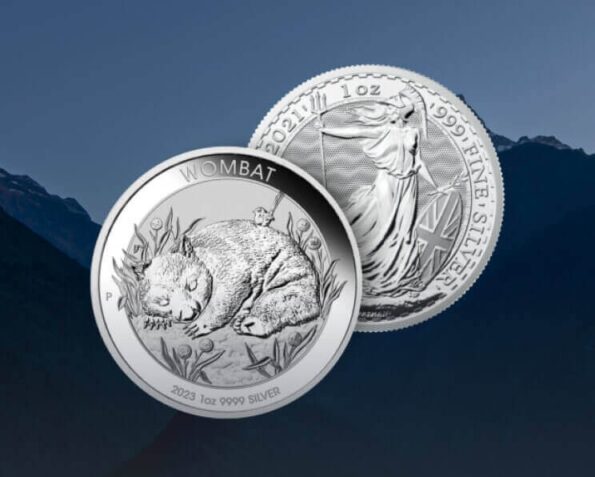
For gold investments, understanding these distinctions matters considerably because purity directly affects both durability and market value. Coins like the 1 oz Britannia Gold Coin exemplify the highest investment-grade purity standards with 99.99% gold content. Investment-grade gold bullion coins from established mints like Perth Mint represent secure options for long-term wealth preservation. The Austrian Philharmoniker, minted by Münze Österreich, demonstrates how premium gold coins achieve investment-grade status through rigorous purity standards and global recognition.
The karat you choose determines not just what you’re buying, but how that gold performs in real-world applications and investment portfolios.
22 Karat Gold: 91.67% Fine Gold Composition

Now that we’ve established how the karat system works as our measurement tool, let’s focus specifically on 22-karat gold—the composition that’s shaped currency and jewelry for centuries. This purity level contains exactly 91.67% pure gold, with the remaining 8.33% comprised of alloy metals like copper and silver.
Why does this matter? Those alloying elements fundamentally change gold’s properties. While 24k gold is softer and more susceptible to scratching, 22k gold gains durability and resilience—crucial qualities for circulating coins and everyday gold jewelry that endure handling and wear. Similarly, collectors seek high-purity silver coins like those containing 99.9% pure silver for both investment potential and preservation.
The American Gold Eagle exemplifies this perfectly, blending 91.67% gold with 3% silver and 5.33% copper. Understanding the 22k vs 24k distinction reveals how purity directly influences not just value, but practical longevity too. Investment-grade bars like the Umicore Gold Bar demonstrate premium quality standards with 99.99% purity and come with authentication certificates. Like the 99.99% gold composition found in premium investment bars, the purity standards of circulating coins demonstrate how gold’s fineness directly correlates with both market value and buyback potential.
Now that we’ve established how the karat system works as our measurement tool, let’s focus specifically on 22-karat gold—the composition that’s shaped currency and jewelry for centuries. This purity level contains exactly 91.67% pure gold, with the remaining 8.33% comprised of alloy metals like copper and silver.
Why does this matter? Those alloying elements fundamentally change gold’s properties. While 24k gold is softer and more susceptible to scratching, 22k gold gains durability and resilience—crucial qualities for circulating coins and everyday gold jewelry that endure handling and wear. Similarly, collectors seek high-purity silver coins like those containing 99.9% pure silver for both investment potential and preservation.
The American Gold Eagle exemplifies this perfectly, blending 91.67% gold with 3% silver and 5.33% copper. Understanding the 22k vs 24k distinction reveals how purity directly influences not just value, but practical longevity too. Investment-grade bars like the Umicore Gold Bar demonstrate premium quality standards with 99.99% purity and come with authentication certificates. Like the 99.99% gold composition found in premium investment bars, the purity standards of circulating coins demonstrate how gold’s fineness directly correlates with both market value and buyback potential.
24 Karat Gold: 99.99% Fine Gold Composition
When we shift our focus to 24k gold at 99.99% purity, we’re looking at the gold investor’s holy grail—maximum precious metal content that means every dollar spent goes directly toward actual gold value rather than supporting alloy metals.
We’ve got several powerhouse options to choose from, including the Canadian Maple Leaf, Austrian Philharmonic, Australian Kangaroo, American Gold Buffalo, Chinese Panda, and British Britannia, each offering that pure investment appeal while catering to different collector preferences and international markets.
The Austrian Philharmonic, minted by Münze Österreich, exemplifies this 99.99% gold standard with its brilliant uncirculated condition and recognition as Austria’s official gold bullion. For American investors seeking comparable quality, the 1/2 oz American Eagle Gold Coin represents a premium investment-grade option with an A-label investment score. The Netherlands also produces notable gold coins through the Koninklijke Nederlandse Munt, offering alternatives for European investors seeking quality bullion options.
The trade-off here’s straightforward: while 24k gold’s softness makes it more prone to scratches than its 22k counterpart, that supreme purity gives serious investors exactly what they want—the brightest yellow hue and the confidence that they’re holding the most concentrated form of gold possible.
Maximum Purity Investment Benefits
Most serious gold investors recognize that 24-karat gold, with its 99.9%-99.99% pure composition, offers distinct advantages that extend beyond simply owning more of the precious metal.
When we incorporate maximum purity into our investment strategies, we’re fundamentally maximizing the gold content per coin while minimizing alloy interference. This matters because 24k gold maintains consistent value across international markets, eliminating complications from varying purity standards in different countries.
Additionally, coins like Canadian Maple Leafs and Austrian Philharmonics command strong resale demand precisely because their exceptional purity appeals to collectors and investors worldwide. Perth Mint bars, produced by one of the world’s most renowned mints, exemplify how trusted mint origins strengthen investor confidence and global market recognition. The Royal Canadian Mint’s quality assurance standards ensure that each coin meets rigorous purity specifications that investors depend on for reliable asset allocation.
We find that 24k gold’s brightness and unmistakable appearance also provide psychological reassurance—you’re holding virtually pure gold, nothing diluted.
For long-term wealth preservation, that maximum purity translates into straightforward, reliable investment value. Bars from recognized smelters like Valcambi further enhance this security through their certificate of authenticity and global recognition, ensuring your investment maintains legitimacy and resale potential across international markets.
Popular 24K Bullion Coins
Several world-renowned mints have established themselves as leaders in producing 24-karat bullion coins, each offering distinct characteristics that appeal to investors seeking maximum purity.
We’ve got several standout options worth considering:
- Canadian Maple Leafs – Features iconic maple leaf designs with .9999 fine gold purity and strong international recognition
- Austrian Philharmonics – Showcases beautiful musical imagery reflecting historical significance while maintaining maximum gold content
- Chinese Pandas – Display annually changing coin designs that collectors appreciate, combining investment value with aesthetic appeal
Each of these coins weighs exactly one troy ounce containing pure gold investment potential. Their coin designs reflect cultural heritage and artistic excellence, making them popular among both serious investors and collectors. The Perth Mint from Australia also produces exceptional 24-karat bullion coins like the Lunar series, maintaining the same high standards of craftsmanship and purity. For investors prioritizing durability and long-term value retention, coins struck in 22-karat gold alloys offer enhanced resilience compared to pure gold alternatives.
The historical significance behind these mints’ production standards guarantees authenticity and quality you can trust when building your portfolio. Canadian Maple Leafs are minted by the Royal Canadian Mint, one of the world’s most trusted sources for bullion production.
When we shift our focus to 24k gold at 99.99% purity, we’re looking at the gold investor’s holy grail—maximum precious metal content that means every dollar spent goes directly toward actual gold value rather than supporting alloy metals.
We’ve got several powerhouse options to choose from, including the Canadian Maple Leaf, Austrian Philharmonic, Australian Kangaroo, American Gold Buffalo, Chinese Panda, and British Britannia, each offering that pure investment appeal while catering to different collector preferences and international markets.
The Austrian Philharmonic, minted by Münze Österreich, exemplifies this 99.99% gold standard with its brilliant uncirculated condition and recognition as Austria’s official gold bullion. For American investors seeking comparable quality, the 1/2 oz American Eagle Gold Coin represents a premium investment-grade option with an A-label investment score. The Netherlands also produces notable gold coins through the Koninklijke Nederlandse Munt, offering alternatives for European investors seeking quality bullion options.
The trade-off here’s straightforward: while 24k gold’s softness makes it more prone to scratches than its 22k counterpart, that supreme purity gives serious investors exactly what they want—the brightest yellow hue and the confidence that they’re holding the most concentrated form of gold possible.
Maximum Purity Investment Benefits
Most serious gold investors recognize that 24-karat gold, with its 99.9%-99.99% pure composition, offers distinct advantages that extend beyond simply owning more of the precious metal.
When we incorporate maximum purity into our investment strategies, we’re fundamentally maximizing the gold content per coin while minimizing alloy interference. This matters because 24k gold maintains consistent value across international markets, eliminating complications from varying purity standards in different countries.
Additionally, coins like Canadian Maple Leafs and Austrian Philharmonics command strong resale demand precisely because their exceptional purity appeals to collectors and investors worldwide. Perth Mint bars, produced by one of the world’s most renowned mints, exemplify how trusted mint origins strengthen investor confidence and global market recognition. The Royal Canadian Mint’s quality assurance standards ensure that each coin meets rigorous purity specifications that investors depend on for reliable asset allocation.
We find that 24k gold’s brightness and unmistakable appearance also provide psychological reassurance—you’re holding virtually pure gold, nothing diluted.
For long-term wealth preservation, that maximum purity translates into straightforward, reliable investment value. Bars from recognized smelters like Valcambi further enhance this security through their certificate of authenticity and global recognition, ensuring your investment maintains legitimacy and resale potential across international markets.
Popular 24K Bullion Coins
Several world-renowned mints have established themselves as leaders in producing 24-karat bullion coins, each offering distinct characteristics that appeal to investors seeking maximum purity.
We’ve got several standout options worth considering:
- Canadian Maple Leafs – Features iconic maple leaf designs with .9999 fine gold purity and strong international recognition
- Austrian Philharmonics – Showcases beautiful musical imagery reflecting historical significance while maintaining maximum gold content
- Chinese Pandas – Display annually changing coin designs that collectors appreciate, combining investment value with aesthetic appeal
Each of these coins weighs exactly one troy ounce containing pure gold investment potential. Their coin designs reflect cultural heritage and artistic excellence, making them popular among both serious investors and collectors. The Perth Mint from Australia also produces exceptional 24-karat bullion coins like the Lunar series, maintaining the same high standards of craftsmanship and purity. For investors prioritizing durability and long-term value retention, coins struck in 22-karat gold alloys offer enhanced resilience compared to pure gold alternatives.
The historical significance behind these mints’ production standards guarantees authenticity and quality you can trust when building your portfolio. Canadian Maple Leafs are minted by the Royal Canadian Mint, one of the world’s most trusted sources for bullion production.
Why Some Coins Use 22k Gold: Durability and History

Because gold’s softness makes it vulnerable to damage, coin manufacturers have long turned to 22k gold as a practical solution that balances purity with longevity. This alloy composition—91.67% gold mixed with copper and silver—delivers historical significance in numismatic traditions.
The American Gold Eagle and South African Krugerrand exemplify how 22k gold serves practical applications, offering superior scratch resistance compared to pure 24k alternatives. These coins’ durability made them ideal for circulation and everyday handling, not merely vault storage.
While 24k gold represents maximum purity, 22k gold’s reinforced structure guarantees coins withstand the wear that comes with real-world use. Understanding this trade-off helps us appreciate why certain coins remain industry standards despite newer, purer options existing today.
Because gold’s softness makes it vulnerable to damage, coin manufacturers have long turned to 22k gold as a practical solution that balances purity with longevity. This alloy composition—91.67% gold mixed with copper and silver—delivers historical significance in numismatic traditions.
The American Gold Eagle and South African Krugerrand exemplify how 22k gold serves practical applications, offering superior scratch resistance compared to pure 24k alternatives. These coins’ durability made them ideal for circulation and everyday handling, not merely vault storage.
While 24k gold represents maximum purity, 22k gold’s reinforced structure guarantees coins withstand the wear that comes with real-world use. Understanding this trade-off helps us appreciate why certain coins remain industry standards despite newer, purer options existing today.
Which Coins Are 22k: Eagles and Krugerrands

When we examine the world’s most recognized gold coins, we’ll find that the American Gold Eagle and South African Krugerrand both maintain the 22-karat standard—containing 91.67% pure gold—but they achieve durability through different alloy compositions.
The Eagle blends its gold content with 3% silver and 5.33% copper, while the Krugerrand relies entirely on copper as its alloy metal.
These distinct formulations create subtle differences in both appearance and performance characteristics.
Understanding these specific compositions helps us appreciate why these coins have remained industry standards for decades, despite newer 24-karat alternatives now dominating the bullion market.
Eagle Composition and Durability
As we explore the world of investment-grade gold coins, we find that two iconic options—the American Gold Eagle and the South African Krugerrand—share a fascinating common trait: they’re both 22-karat gold coins, a choice that directly shapes their durability and real-world performance.
The American Gold Eagle contains 91.67% gold combined with 3% silver and 5.33% copper. This specific composition creates exceptional eagle durability, allowing collectors to handle these coins without worrying about scratches that’d plague their 24k counterparts. The alloy metals strengthen the gold, making it ideal for circulation and storage.
Here’s what makes this composition work:
- Enhanced resistance to wear and surface damage
- Rich yellow color that remains visually appealing
- Proven historical reliability across decades of coin popularity
This durability advantage explains why the American Gold Eagle remains the world’s most popular gold coin despite competing against purer alternatives.
Krugerrand’s Copper Alloy Blend
While the American Gold Eagle opts for a three-metal blend featuring silver alongside copper, the South African Krugerrand takes a distinctly different approach by using copper as its sole alloy component. This composition decision reflects Krugerrand history and the alloy significance in achieving optimal durability. The pure copper addition strengthens the coin without compromising its distinctive warm, reddish-gold appearance.
| Aspect | American Gold Eagle | South African Krugerrand |
|---|---|---|
| Gold Content | 91.67% | 91.67% |
| Silver | 3% | 0% |
| Copper | 5.33% | 8.33% |
| Total Weight | 1.1 troy oz | 1.1 troy oz |
| Pure Gold | 1 troy oz | 1 troy oz |
We appreciate how this copper-focused formula enhances the Krugerrand’s resistance to wear, making it exceptionally suitable for handling and circulation throughout its storied legacy.
Which Coins Are 24k: Maple Leafs, Buffalos, Britannias, and Kangaroos

The world’s most prestigious modern bullion coins—Canadian Maple Leafs, American Gold Buffalos, British Britannias, and Australian Kangaroos—all share a significant distinction: they’re minted from 24-karat gold, meaning they contain 99.9% or higher pure gold content.
The world’s most prestigious bullion coins—Canadian Maple Leafs, American Gold Buffalos, British Britannias, and Australian Kangaroos—are minted from 24-karat gold.
We’ve identified these coins as investor favorites for several reasons:
- Maximum purity: Each contains exactly one troy ounce of pure gold, making coin identification straightforward for bullion preferences.
- International recognition: Their prestigious mints guarantee authenticity and consistent quality standards.
- Investment appeal: The highest gold content available in circulating bullion coins attracts serious collectors.
These 24k coins weigh slightly more than 22k alternatives since they contain minimal alloy metals. Their bright yellow luster and pure composition make them ideal for investors prioritizing maximum gold content over durability, fundamentally shaping modern bullion preferences worldwide.
How Purity Affects Investment Value

When we compare 22k and 24k gold coins as investments, we’re really evaluating how that extra purity translates into real financial value—and here’s where it gets interesting: while a 24k coin contains more pure gold by weight, both the American Gold Eagle (22k) and the Canadian Maple Leaf (24k) deliver exactly one troy ounce of pure gold content, meaning their intrinsic gold value at spot price remains virtually identical despite their different purities.
The market price implications become more nuanced when we factor in premiums, import regulations across different countries, and collector demand. Some jurisdictions actually tax lower-purity gold more heavily, which can make the supposedly “purer” investment surprisingly less advantageous depending on where you’re buying and selling.
Understanding this relationship between purity, weight, and actual gold content helps us recognize that maximum purity doesn’t automatically mean maximum investment value—it’s the total gold ounces you’re acquiring that ultimately drives your returns.
Pure Gold Content Comparison
One fundamental principle underlies all gold investment decisions: the actual amount of pure gold you’re acquiring matters far more than the coin’s total weight.
When we compare 22k and 24k coins, we’re really examining how gold grading standards translate into real investment value.
Here’s what makes this comparison essential:
- A 22k coin weighing 1.1 troy ounces contains exactly 1 troy ounce of pure gold
- A 24k coin weighing 1 troy ounce contains exactly 1 troy ounce of pure gold
- Both ultimately give you identical pure gold content despite different total weights
Understanding this equivalence helps you navigate investment risks effectively.
You’re not losing value by choosing 22k coins; you’re simply accepting different durability characteristics.
The spot price determines your actual gold’s worth, not the coin’s purity designation alone.
Market Price Implications
Because we’ve established that 22k and 24k coins contain identical pure gold content, you might assume they’d sell for the same price—but that’s where market dynamics get interesting.
The reality involves price fluctuations tied directly to purity perception and market demand. While 24k coins command higher per-ounce premiums due to maximum gold content, 22k coins often carry lower markups, making them attractive for budget-conscious investors.
International market demand shifts these valuations considerably; certain regions favor specific purities based on cultural preferences and import regulations. When spot gold prices rise, both purities climb proportionally, yet their premium structures remain distinct.
We’ve found that understanding these pricing variations helps investors strategically select coins matching their financial goals and regional market conditions.
Premium Differences Between 22k and 24k Coins

The price gap between 22k and 24k gold coins isn’t simply about the difference in pure gold content—it’s more nuanced than that.
We’ve found that premiums reflect several factors beyond purity alone:
- Collector preferences often drive 24k coin values higher, as investors increasingly seek maximum purity
- Mintage numbers and brand reputation considerably influence pricing across both purities
- Investment trends show growing demand for 24k coins, affecting market premiums
While both contain equivalent gold weight, 24k coins typically command higher per-ounce premiums due to their purity appeal.
However, 22k coins sometimes maintain competitive premiums in certain markets where durability and historical significance matter.
Understanding these premium dynamics helps us make informed purchasing decisions, recognizing that the cheapest coin isn’t necessarily the best value when considering long-term collectibility and market demand.
Does Higher Purity Mean Better Investment

While premium dynamics certainly matter when you’re comparing coins side by side, they’re really just one piece of the investment puzzle—and that brings us to a more fundamental question: does chasing higher purity actually make for a smarter investment?
The short answer? Not necessarily.
Both 22k and 24k coins contain equivalent gold content by weight, so their intrinsic value tracks the same spot price. What matters more are investment risks and market trends.
Consider that 24k coins command higher per-ounce prices due to purity, yet you’re not getting additional gold for your money—just paying more for that extra refinement.
Your investment success depends less on purity choice and more on factors like timing, diversification, and understanding which markets prefer specific standards.
Select based on your market’s demands, not purity alone.
Choosing Between 22k and 24k for Your Portfolio

Now that you understand how purity affects value and why higher karat doesn’t automatically mean better returns, you’re ready to make a choice that actually fits your specific situation.
Your decision hinges on several practical factors:
- Investment longevity: 22k coins endure handling better due to their alloy content, while 24k requires careful storage to prevent scratches.
- Portfolio diversification: Consider mixing both purities to hedge against market preferences and regulatory changes across different countries.
- International accessibility: Some nations impose higher import taxes on lower-purity gold, potentially affecting your 22k coins’ resale value.
Ultimately, both contain equivalent gold content per troy ounce.
Both 22k and 24k gold contain equivalent gold content per troy ounce, regardless of purity differences.
Your choice depends on where you’ll store your investment, which markets you’ll eventually access, and whether durability matters for your specific financial goals.
People Also Ask
Do Certain Countries Impose Import Taxes Based on Gold Coin Purity Levels?
Yes, certain countries impose higher import taxes on lower-purity gold coins. We’ve found that some nations mandate minimum purity standards, affecting tax implications and import regulations for investors selecting coins internationally.
How Does Gold Purity Affect Shipping and International Transportation of Bullion Coins?
We’ve found that higher-purity 24k coins often face lower import taxes during bullion transportation, making gold shipping costs more favorable. You’ll discover 22k coins sometimes incur steeper duties internationally.
Why Does the American Gold Eagle Remain Popular Despite Lower Purity Than Alternatives?
We appreciate the American Gold Eagle’s enduring popularity because of its historical significance and strong collector preferences. Its 22k composition doesn’t diminish its appeal—it’s actually built durability we value.
Are There Specific Cultural or Regional Preferences for 22K Versus 24K Gold Coins?
We’ve found strong cultural significance and regional preferences shape coin selection. Many Asian markets favor 22k gold for traditional jewelry, while Western investors increasingly prefer 24k bullion coins for maximum purity investment goals.
How Do Spot Price Calculations Account for Weight Differences Between 22K and 24K Coins?
We use weight adjustment formulas to calculate pure gold content, then apply the spot price to that figure for market valuation. Since 22k coins weigh more to contain equivalent pure gold, we’re comparing identical gold value despite different total weights.
The Bottom Line
We’ve explored how purity shapes your gold investment strategy, and here’s what matters: 24k gold’s near-perfect composition makes it virtually indestructible as an investment, while 22k coins offer practical durability for collectors. Your choice hinges on whether you’re prioritizing maximum gold content or appreciating numismatic appeal. Both serve legitimate portfolio roles—it’s about matching your financial goals with the right karat selection.
When you’re ready to buy precious metals, BlokGold makes the process seamless by offering a crypto precious metals exchange platform that eliminates the delays and high fees associated with traditional dealers. Whether you’re seeking physical gold coins or other precious metals, BlokGold provides immediate access to authentic bullion through cutting-edge precious metals purchasing today. Rather than waiting for future market opportunities or committing to expensive traditional dealer arrangements, you can now buy precious metals with cryptocurrency and receive your physical assets without unnecessary financial risk. BlokGold’s innovative approach to the precious metals market ensures you get real value and real metal—today.
References
- https://www.schiffgold.com/faq/what-are-the-pros-and-cons-of-24k-vs-22k-gold-coins
- https://bulliontradingllc.com/blog/pure-gold-coins-vs-22k-gold-coins-91-67/
- https://www.pimbex.com/article/what-is-the-difference-between-24k-22k-and-18k-gold/
- https://www.bajajfinserv.in/what-is-difference-between-22k-and-24k-gold
- https://www.josalukkasonline.com/blog/gold-standards-unveiling-the-difference-between-22-kt-gold-coin-and-24-kt-gold-coin/
- https://www.24gold.ca/blogs/understanding-gold-purity-24k-vs-22k-and-other-common-grades