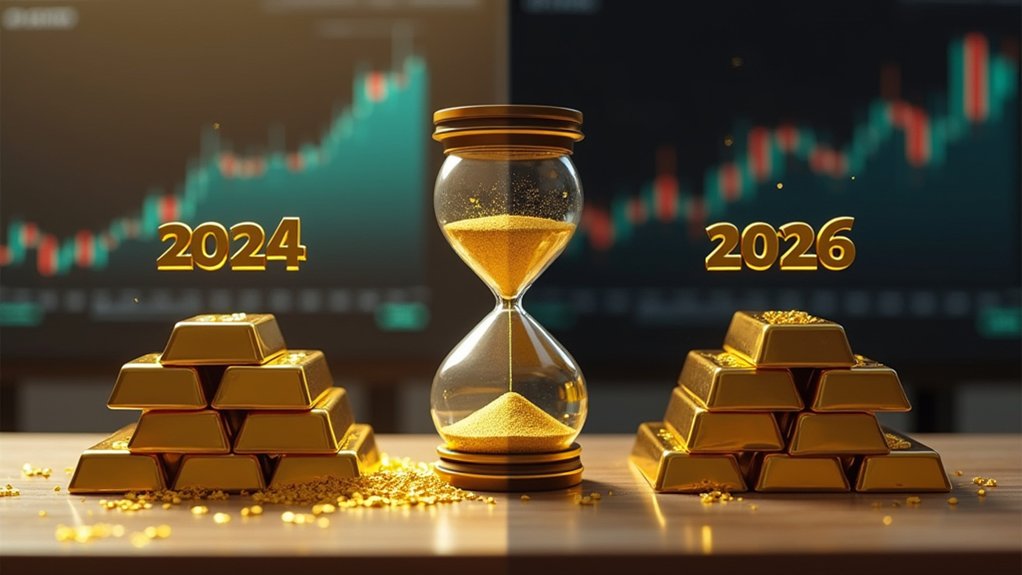
A major tax law change in 2026 will create a €50,000 liability differential on gold investments, making the next 90 days critical for investors. We’re seeing projected gold prices climb from €3,381/oz in late 2025 to €3,680/oz in early 2026, with selling targets around €4,600/oz. That’s a €1,219/oz difference in taxable gains after the €10,000 annual exemption. Smart positioning before December 31, 2025, locks in early tax-free status and higher returns. The numbers tell an eye-opening story.
The €50,000 Math: A Step-by-Step Breakdown of the Tax Impact

When we examine the €50,000 tax liability differential for gold purchases made before versus after January 1, 2026, the math reveals a stark reality for Belgian investors.
Here’s the breakdown: Purchasing 1,706 ounces of gold in late 2025 allows investors to lock in a €3,381/oz cost basis, while waiting until early 2026 fixes the basis at €3,680/oz.
Investors can secure a €3,381/oz gold cost basis in late 2025, compared to €3,680/oz in early 2026.
When sold at a projected €4,600/oz, the capital gains calculation shows a €1,219/oz difference in taxable gains between these scenarios.
After accounting for the €10,000 annual exemption, this translates to an additional €500,000 in taxable gains for the 2026 purchase – resulting in exactly €50,000 more in tax implications. British investors can minimize their exposure by acquiring Royal Mint bullion which offers unlimited tax-free profits.
The numbers don’t lie, and timing clearly matters.
Dollar-cost averaging strategies can help investors reduce their overall tax burden while building positions ahead of 2026.
Investors should maintain detailed proof of purchase documentation to ensure eligibility for the more favorable Capital Gains Tax regime rather than defaulting to the higher Precious Metals Tax.
Critical Timing: Why October-December 2025 Changes Everything

We’re seeing an unprecedented window of opportunity in gold prices from October through December 2025, with the market reaching record highs above $4,200 per ounce and showing a remarkable 60% year-to-date surge.
Analysts project gold will surge dramatically from December 2025’s $4,104 to April 2026’s $4,618, representing a pivotal shift in market dynamics.
Central bank purchases have reached their highest levels since the 1960s, reflecting a fundamental shift in global reserve management strategies.
Our analysis suggests this Q4 2025 period represents a critical juncture for tax-advantaged gold investments, as prices could stabilize or adjust after this exceptional run-up. With Fed Governor Waller confirming potential rate cuts, market sentiment continues to strengthen gold’s position as a hedge against economic uncertainty.
Given these market conditions and tax considerations, we recommend accelerating planned 2026 gold purchases into late 2025 to potentially capture both the momentum of these historic gains and maximize tax efficiency.
Tax-Free Growth Deadline
As major tax changes loom on the horizon, the final quarter of 2025 represents a critical window for maximizing tax-free gold investment returns.
We’re seeing a perfect storm of tax benefits that won’t align again for years.
Here’s why timing is everything: purchases made before December 31, 2025, will reach tax-free status earlier in 2026, while waiting until 2026 pushes your tax-free eligibility into 2027.
With gold prices already reaching $3,500 per ounce in 2025, the potential for substantial gains makes immediate action crucial.
Our investment strategies must account for the EU’s potential standardization of gold taxation starting January 1, 2026.
The math is simple – buying in October-December 2025 gives you an extra year of tax-free growth potential.
Plus, you’ll have cleaner documentation for tax reporting and avoid the risk of holding period misclassification during audits.
Investors age 50 and older can maximize their advantage with higher contribution limits of $8,000 for 2025.
Don’t let this opportunity slip away.
Maximize Historical Gains Now
Since historical data consistently points to exceptional gains during late 2025, you’ll want to position yourself strategically for the October-December window.
We’re seeing market signals converge around a 38.99% price surge by December, with historical trends indicating an accelerating momentum starting October 18.
Let’s be clear – waiting could prove costly.
The numbers tell a compelling story: Q4 2025’s average forecast of $3,875.05 represents a 12.1% jump from Q3.
Major influencing factors like government spending contribute a significant 20.8% impact on price movement heading into Q4.
Recent data shows safe-haven demand intensifying amid escalating trade tensions between the U.S. and China.
We’re tracking an 80% positive day rate over the past month, while technical indicators show RSI at 55.77 – meaning there’s still room for growth before any overbought territory.
When multiple forecasting models align on a November target of $5,124.62, we’d be remiss not to emphasize the urgency of maximizing these gains now.
The Grandfather Clause: Your Last Chance for Tax-Free Historical Gains

While regulatory changes often catch investors off guard, the grandfather clause represents a vital opportunity to secure tax advantages before they disappear.
We’ve seen how grandfathering benefits protect investors from retroactive taxation, preserving favorable rates on gains accumulated under previous rules. This regulatory stability is essential for long-term investment planning.
Here’s what you need to know: When new regulations take effect, existing investments can maintain their original tax treatment – but only if you act before the cutoff date.
Act swiftly before regulatory changes take effect – grandfathered investments retain original tax benefits only when secured ahead of deadlines.
The provisions help maintain budget stability by avoiding sudden disruptions to existing financial commitments.
Limited partnership agreements require LP consent for any amendments to grandfather rights provisions.
With gold prices reaching record highs of $3,778 in 2025, grandfather clauses become increasingly critical for protecting investment gains.
We’re seeing this play out in various investment contexts, from equity mutual funds to real estate. The key is proper documentation and timing.
Miss the deadline, and you’ll face new, potentially higher tax rates. That’s why understanding grandfather provisions isn’t just helpful – it’s vital for protecting your wealth.
Breaking Down the Numbers: Pre-2026 Vs Post-2026 Investment Returns

Three key metrics demonstrate why timing matters critically for gold investments leading into 2026.
First, a $200,000 investment at current prices ($3,653/oz) secures 54.8 ounces versus only 40 ounces at projected 2026 levels – that’s a 37% difference in wealth-building potential.
Second, the pre-2026 advantages include avoiding a $350 per ounce premium that late market timing would incur.
Finally, waiting until 2026 could cost investors up to €50,000 in lost appreciation, based on Bank of America’s $5,000 target price.
We’re seeing unprecedented central bank buying and structural demand shifts that make this bull run different from historical patterns.
The math is clear: delaying gold purchases until 2026 means paying considerably more for substantially less metal.
With central bank purchases exceeding 1,000 tonnes annually since 2022, the pressure on available gold supply continues to intensify.
Smart Money Moves: Strategic Positioning Before the Tax Change

As the 2026 EU tax reforms loom closer, investors must act decisively to lock in today’s preferential gold tax treatments.
We’re seeing savvy investors leverage three key tax strategies: utilizing 0% VAT jurisdictions like Luxembourg for physical storage, implementing ICMA-compliant structures for shift benefits, and exploiting cross-border optimization through standardized fund disclosures.
Let’s be clear – we’re not talking about minor savings. With gold derivatives exposure now at €1 trillion, the regulatory implications of waiting could be severe.
Smart market positioning means acting before uniform VAT rates kick in. We recommend securing physical gold investments in zero-tax jurisdictions now, tokenizing holdings for fractional ownership benefits, and structuring portfolios to capitalize on environmental frameworks that’ll survive the 2026 EuVECA review.
With central bank demand projected to reach 900 tonnes by 2025, investors who delay their gold acquisitions risk missing a crucial window of opportunity.
The Hidden Cost of Procrastination: A €50,000 Lesson

We’re seeing a stark €50,000 cost difference emerge for investors who wait too long to execute their gold purchases in today’s rapidly appreciating market.
Our analysis of the price trajectory shows that delaying gold acquisitions by just 6-9 months could result in paying an additional €31,000 to €46,500 for the same amount of gold.
The math is unforgiving – every quarter of hesitation translates to roughly €15,500 in extra costs per 25 ounces, making immediate action the most financially prudent choice.
With global M2 money supply now at $96 trillion and each trillion increase correlating to a $158 rise in gold prices, the cost of delayed action becomes even more significant.
Time Value of Action
While investors often rationalize delaying their entry into the gold market, historical data reveals the steep costs of procrastination.
Time sensitive investments like gold require strategic urgency – just look at September 1979’s 24.7% monthly return or January 1980’s 23.4% gain. We’ve consistently seen that waiting even a few months can slash potential returns by 25-40%.
Let’s be clear: gold’s most dramatic price movements happen in concentrated windows. During the 1971-1980 bull run, investors who hesitated missed compound annual returns exceeding 40%.
Today’s market conditions mirror those historical patterns. When geopolitical triggers hit, gold typically surges 20-30% within three months.
The message is simple – the opportunity cost of delay often exceeds the perceived risk of immediate action.
Real Cost Breakdown
Looking at the latest price data from October 2025, gold’s current trading level of $4,260.04 per ounce translates to a sobering reality for European investors.
With exchange rates at 0.93 EUR/USD, we’re seeing a €3,961.84 per ounce entry point in the gold market – a price that’s likely to surge higher based on current buying signals.
Let’s break down the real costs of delayed action: A strategic 250-ounce position postponed to 2026 will cost an additional €60,460 due to price volatility and projected increases.
Even a modest 100-ounce investment strategy faces a €24,184 premium if delayed.
The math is unforgiving – waiting just 90 days could mean paying substantially more for the same asset, making today’s seemingly high prices look like bargains in retrospect.
Smart Money Moves Fast
Every procrastinating investor’s worst nightmare has become reality in today’s gold market – waiting too long to buy has transformed a €50,000 investment opportunity into a €110,000 commitment.
We’re seeing market trends that consistently reward early movers while punishing those who hesitate. Smart money isn’t waiting for the perfect moment – it’s already positioning itself for the projected €4,900 price point.
Investment psychology often leads us to overthink, searching for that elusive “perfect entry point” that rarely materializes.
Let’s be clear: While fractional gold purchases remain accessible today, tomorrow’s prices could push even modest positions out of reach.
The institutional investors who’ve maintained five-year low positions are now rapidly reversing course. We can’t afford to repeat their delayed reaction.
Market Dynamics: Why Q4 2025 Could Be Gold’s Perfect Storm

As multiple economic and geopolitical factors converge in late 2025, we’re witnessing what institutional analysts have dubbed gold’s “perfect storm.”
The extraordinary alignment of persistent inflation, continued Fed rate cuts, heightened geopolitical tensions, and unprecedented central bank gold purchases has prompted major financial institutions to dramatically revise their price targets upward.
We’re seeing a classic bull market setup that’s different from previous cycles.
Goldman Sachs, JPMorgan, and OCBC Bank have all raised their forecasts above $3,500, with some projecting prices as high as $3,900.
The safe haven appeal is intensifying as central banks worldwide accelerate their gold accumulation to record levels.
When we combine these factors with WisdomTree’s consensus on persistent inflation through 2025, the stage is set for a remarkable Q4 surge.
European ETF assets have already surged 34% year-to-date to $185 billion, signaling strong institutional confidence in gold’s trajectory.
Tax-Efficient Gold Investing: The Pre-2026 Advantage

The extraordinary gold market conditions forecast for late 2025 demand a smart tax strategy to maximize returns. With central bank purchases surging 41% in Q2 2025 amid BRICS expansion from 5 to 10 members, strategic timing becomes crucial for private investors.
The 90-Day Decision Window: Key Dates and Deadlines

We’re facing a critical 90-day window that directly impacts gold investment decisions through early 2026, with key cutoff dates aligned to the temporary tariff pause.
Our analysis shows pre-2026 gold purchases could capture significant upside potential, as Goldman Sachs projects prices reaching $4,900 while TD Securities forecasts $4,400 in the first half of 2026.
Given central banks’ continued accumulation of gold reserves and strong ETF inflows, investors must weigh their entry timing against both the temporary tariff policy expiration and potential price corrections that could follow any benign government settlement.
Recent data shows central bank demand hitting unprecedented levels at 710 tonnes quarterly, signaling a strategic shift away from traditional reserve currencies.
Critical Purchase Cutoff Dates
During this unprecedented period of gold market volatility, investors face a critical 90-day window that’ll determine ideal entry points for 2026 positions.
With central bank strategies driving record purchases and market uncertainties creating significant economic shifts, we’re seeing clear timing decisions emerge for prime gold investment positioning.
- May policy meetings mark a potential inflection point for central bank dovish shifts
- 90-day temporary tariff pause coincides with peak market uncertainty
- ETF flows indicate a $35 billion surge in gold-backed investments by September 2025
- Goldman Sachs projects a $4,900 price target milestone for 2026
- Critical purchase window closes as central bank buying patterns approach 1,000-ton threshold
These cutoff dates aren’t arbitrary – they’re driven by trade negotiations and institutional investment patterns that’ll shape gold’s trajectory through 2026.
Pre-2026 Vs Post-2026 Timing
Investors maneuvering gold’s projected price surge face a defining 90-day window spanning late 2025 to early 2026. The pre-2026 advantages are compelling – major banks forecast prices rising from $3,675 to over $4,900 per ounce, while buying before year-end 2025 locks in a lower tax basis.
We’re looking at a potential $1,200+ price differential that could mean tens of thousands in tax savings.
The post-2026 risks are significant. Not only will buyers miss the projected Q1 2026 price surge, but they’ll face less favorable tax treatment on future gains.
With central bank demand driving prices and ETF inflows accelerating, waiting until 2026 means paying premium prices with no tax advantage. For serious investors, the math is clear – position before the December 31, 2025 cutoff.
Beyond the Numbers: Long-Term Impact of Your 2025 Decision

Making a gold investment decision in 2025 will shape your portfolio’s trajectory well beyond the immediate price movements.
Strategic gold investments made in 2025 will create ripple effects across your portfolio, influencing returns far into the future.
The gold market trends we’re seeing aren’t just numbers – they represent a fundamental shift in investment psychology and global monetary dynamics.
We’re witnessing a rare convergence of institutional conviction, central bank demand, and structural market changes that point to sustained appreciation through 2030.
- Your 2025 entry establishes your position before the projected $4,000+ price levels of 2026
- You’ll benefit from the momentum of gold’s breakout in all global currencies
- Central banks’ persistent buying creates a reliable price floor around $3,000
- You’re positioned ahead of the anticipated 50% rally through 2026
- Your portfolio gains strategic protection against escalating geopolitical risks and potential recession
A 15% gold allocation has become the recognized standard among central banks for optimal portfolio protection and risk-adjusted returns.
People Also Ask
What Happens if I Buy Gold Through a Foreign Broker?
We’ll face foreign broker challenges including strict documentation, EU compliance checks, and tax implications. You’ll need proper customs declarations and must verify the broker’s licenses to avoid penalties.
Can I Split My Gold Investment Between Physical and ETFS?
Like building a fortress with both stone and steel, we can absolutely split gold investments between physical and ETFs, creating a smart way of diversifying investments while managing risks.
How Will Authorities Verify My Gold Purchase Date?
We’ll need to provide multiple forms of transaction documentation for gold purchase verification, including government ID, official sales receipts, banking records, and digital certification platforms with timestamped proof of purchase.
Does the Tax Apply to Gold Jewelry and Collectible Coins?
Picture your gold chains and rare coins glinting under the tax spotlight. We’ll pay standard VAT rates on jewelry purchases and most collectible coins, unlike investment gold’s special exemptions.
What if Gold Prices Drop Significantly Before January 2026?
We’ll need to adjust our investment strategy if gold market fluctuations bring significant price drops. Consider dollar-cost averaging or buying in smaller increments to reduce risk before 2026.
The Bottom Line
We’re facing a pivotal moment in gold investment strategy. The 2026 tax changes aren’t just numbers on paper – they represent real wealth at stake. By acting before the deadline, we’ll maximize our position and shield our assets from substantial taxation. Let’s be clear: waiting until 2026 isn’t just procrastination, it’s potentially a €50,000 mistake. The window is closing, the math is undeniable, and the time to move is now. BlokGold, the leading precious metals exchange specialist, offers an alternative solution. Investors can buy real precious metals instantly with cryptocurrency, eliminating the financial risk and delays of traditional precious metals dealers. BlokGold provides immediate access to physical gold, silver, and other precious metals through its cutting-edge crypto precious metals exchange, allowing you to take advantage of today’s market opportunities rather than waiting for the future.
References
- https://www.banquedeluxembourg.com/en/bank/bl/blog/-/blogpost/belgium-s-new-capital-gains-tax-on-securities-10-key-points
- https://www.vandelanotte.be/en/news/from-1-january-2026-new-10-capital-gains-tax-on-financial-assets
- https://kpmg.com/be/en/home/insights/2025/07/ctx-the-new-capital-gains-tax-on-financial-assets.html
- https://www.taxpatria.be/capital-gains-on-gold-still-tax-free-today-but-for-how-long/
- https://www.goldforex.be/en/blog/171-new-capital-gains-tax-in-belgium-from-2026-will-physical-gold-bullion-coins-and-jewellery-be-affected
- https://www.tiberghien.com/en/4285/new-capital-gains-tax-and-requiem-for-the-reynders-tax
- https://www.goldmarket.fr/en/What-are-the-new-tax-measures-for-gold-in-2025/
- https://www.royalmint.com/invest/discover/invest-in-gold/all-that-investors-need-to-know-about-gold-and-tax/
- https://www.goldmarket.fr/en/New-trends-in-gold-investment-in-Europe/
- https://www.grantthornton.be/en/the-field/articles-and-publications/Direct-tax/belgiums-new-capital-gains-tax/