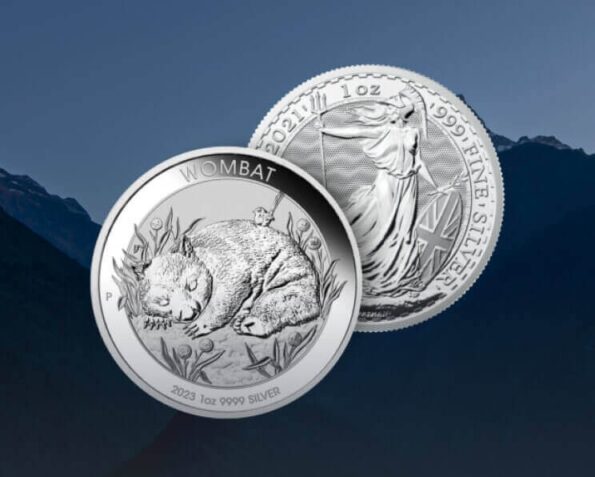

We can’t overlook silver’s powerful diversification benefits in today’s portfolios. With a 0.9 correlation to gold but near-zero correlation to stocks and bonds, silver provides unique protection during market stress. Modern Portfolio Theory suggests a 4-6% allocation optimizes risk-adjusted returns, while silver’s dual role as both safe-haven and industrial metal adds stability. Its price movements often counter equity markets, making it especially valuable when traditional assets falter. Let’s explore how silver’s correlation matrix transforms portfolio resilience.
Understanding Silver’s Correlation Matrix

When examining silver’s correlation matrix, we’ll find that this precious metal exhibits fascinating relationships with other asset classes. The strongest connection exists with gold, showing a remarkable 0.9 correlation coefficient that explains 81% of silver’s price movements. This relationship remains robust across different market conditions, though volatility behavior can trigger notable correlation shifts. Investors should note that correlation is not causation when analyzing these relationships.
While silver maintains a weaker but still meaningful relationship with equity markets, reflected in its modest correlation with the S&P 500, this connection isn’t static. During high market volatility, we often see these correlations fluctuate considerably, sometimes approaching zero or turning slightly negative. Monthly data analysis reveals a constant decline of 0.8% in silver prices without sufficient increases in other factors. Silver’s industrial demand impact on price movements is particularly evident in its 56% industrial usage rate, creating more pronounced market reactions compared to gold.
What’s particularly interesting is silver’s 1.6x regression coefficient relative to gold, confirming that silver typically demonstrates more dramatic price swings than its yellow metal cousin.
Modern Portfolio Theory and Silver Allocation

Modern Portfolio Theory revolutionizes our approach to silver allocation by providing a quantitative framework for maximizing risk-adjusted returns.
We’re seeing clear evidence that silver allocation strategies should comprise 4-6% of well-diversified portfolios, though most institutions currently maintain less than 0.2%.
When we examine modern portfolio adjustments, the data shows silver’s ideal weighting varies by risk tolerance: 5.6% for low-risk, 6% for medium-risk, and 5.8% for high-risk portfolios.
Optimal silver allocation shifts based on investor risk profiles, ranging from 5.6% to 6% across conservative to aggressive portfolios.
We’ve found that silver’s unique characteristics as both a safe-haven asset and growth commodity create compelling diversification benefits. The strong demand from industrial applications represents over 50% of global silver consumption.
Similar to gold investments, silver holdings can be optimized through tax-advantaged accounts to preserve wealth during inflationary periods.
The precious metal exhibits 2-3 times higher volatility compared to gold, offering enhanced growth potential for balanced portfolios.
The metal’s relatively low correlation with major asset classes, except gold, helps reduce overall portfolio risk.
Oxford Economics’ research confirms these benefits, projecting enhanced portfolio efficiency through 2032 with dedicated silver positions.
Risk-Return Characteristics in Mixed Portfolios

Despite silver’s higher volatility compared to traditional defensive assets, its inclusion in mixed portfolios creates compelling risk-return characteristics that we can’t ignore.
We’re seeing ideal allocations of 4-6% enhance risk-adjusted returns while providing essential diversification benefits. Silver’s low correlation with stocks and bonds helps smooth out portfolio performance, especially during market turbulence. The projected 149 million ounce deficit by 2025 strengthens the case for silver allocation. If you encounter access restrictions when researching silver investments online, contact the website administrators directly for resolution.
Traditional PCE inflation hedges have proven largely ineffective during 2021-2023, making silver’s role increasingly important.
While silver volatility runs higher than gold’s, we’ve found it acts as an effective buffer during equity market downturns.
For investors seeking amplified returns, silver mining stocks offer greater upside potential – though we must carefully evaluate this against their increased risk profile.
The current gold/silver ratio suggests silver may be undervalued, presenting an opportune moment to contemplate strategic allocation in mixed portfolios.
Market Cycle Performance Analysis

During bull markets, silver often amplifies broader market gains while maintaining modest correlation to equities, creating powerful portfolio enhancement effects.
When bear markets emerge, silver’s historical tendency to move inversely to stocks while responding positively to crisis conditions makes it an effective portfolio stabilizer and wealth preservation tool.
Between 2001 and 2011, silver demonstrated exceptional performance with an impressive 806% price increase, highlighting its potential to generate substantial returns during extended bullish cycles.
Bull Market Correlation Patterns
Recent silver market patterns reveal a distinctive correlation shift during bull market phases, particularly when examining the metal’s relationship with gold and broader commodity indexes. We’re seeing silver’s traditional linkage to gold weaken as bull markets mature, creating unique diversification benefits for portfolios. The current supply deficit of 182M ounces for 2024 reinforces silver’s potential for stronger price performance independent of other metals. Recent technical analysis confirms a major breakout phase as gold surpasses its primary channel’s upper boundaries.
| Correlation Phase | Silver-Gold | Silver-Copper | Portfolio Impact |
|---|---|---|---|
| Early Bull | 0.85+ | 0.45-0.55 | Moderate |
| Mid Bull | 0.65-0.75 | 0.55-0.65 | Strong |
| Peak Bull | 0.45-0.55 | 0.65-0.75 | Maximum |
| Correction | 0.80+ | 0.35-0.45 | Limited |
Silver prices typically outperform during mid to late bull market stages, as evidenced by the gold-to-silver ratio’s descent from current levels near 87 toward the historical mean of 53. This decorrelation pattern creates strategic opportunities for portfolio rebalancing and risk management.
Bear Market Protection Capacity
While silver often gets marketed as a safe haven during market downturns, its actual bear market protection capacity reveals a more nuanced story.
Historical data shows silver’s bear market resilience is inconsistent, with performance largely dependent on its own market cycle rather than broader market conditions.
We’ve found that silver typically underperforms gold during severe downturns, as evidenced by expanding gold-silver ratios. During the 2007-2009 Financial Crisis, silver ended roughly flat while gold rallied.
Silver’s dual role as both monetary and industrial metal can actually work against it – economic weakness often dampens industrial demand just when safe-haven appeal is most needed.
Let’s be clear: silver’s strongest gains during market stress (+15% in 1970s) coincided with its own bull market rather than providing reliable crash protection.
Economic Growth Impact Analysis
Understanding silver’s economic growth dynamics requires examining its unique dual role as both an industrial metal and monetary asset.
We’ve seen silver’s industrial demand sensitivity increase markedly since 2000, with its correlation to copper prices reaching a beta of 0.4 – a clear indicator of its growing economic sensitivity.
The metal’s extensive use in electronics, EVs, and solar panels means it’s deeply embedded in manufacturing cycles. Yet what makes silver particularly interesting for portfolios is how it responds to economic data.
When employment numbers weaken, central banks typically ease policy, benefiting silver through both industrial and investment channels.
We’re also seeing demographic trends support demand, with the global silver economy expanding rapidly, especially in Asia where spending is projected to more than double by 2030.
Geographic Diversification Benefits

As savvy investors navigate today’s interconnected markets, geographic diversification stands out as a cornerstone strategy for building resilient portfolios.
We’ve found that a well-designed geographic portfolio helps shield against regional risks while capturing growth opportunities across multiple economic cycles. By spreading investments across different countries and continents, we’re able to tap into various market phases simultaneously.
Let’s be clear: effective diversification strategies extend beyond simply buying international stocks. We must consider currency effects, which can provide an additional buffer against market volatility.
Global opportunities in emerging markets often offer higher growth potential than domestic investments alone, while investment resilience comes from exposure to different economic engines. When one region faces challenges, strength in others helps maintain portfolio stability.
Crisis Period Behavior and Portfolio Impact

Let’s explore how silver behaves during periods of market shock and economic crisis, as its performance during these times reveals critical insights for portfolio protection.
We’ve found that silver’s low correlation with traditional assets like stocks and bonds makes it particularly valuable when markets experience severe downturns.
The data shows that strategic silver allocations of 4-6% have historically improved risk-adjusted returns during crisis periods, while helping shield portfolios from the full impact of market crashes.
Market Shock Protection Analysis
During severe market shocks, silver emerges as a potent portfolio stabilizer due to its low correlation with traditional financial assets. We’ve observed that silver price dynamics often move counter-cyclically to stocks and bonds, offering vital protection when markets tumble. The tangible asset benefits of silver become especially apparent during financial crises, as it carries no counterparty risk.
| Market Condition | Silver Behavior | Portfolio Impact |
|---|---|---|
| Equity Crash | Counter-cyclical | Risk reduction |
| Banking Crisis | Safe haven flows | Stability boost |
| Currency Shock | Value preservation | Wealth protection |
| Supply Chain Disruption | Industrial demand support | Sector diversification |
| Geopolitical Events | Flight to safety | Volatility hedge |
A strategic 4-6% silver allocation has proven effective in reducing portfolio drawdowns while enhancing risk-adjusted returns during market stress periods.
Silver During Economic Downturns
While silver’s reputation as a safe-haven asset draws investors during market turmoil, its behavior in economic downturns reveals a more complex pattern than many expect.
We’ve observed that silver volatility often intensifies during crisis periods, with price swings exceeding those of gold and major stock indices. This volatility stems from silver’s dual nature as both an investment metal and industrial commodity.
During recessions, we see industrial demand typically contract sharply, creating downward price pressure. Yet this same pressure can create compelling entry points for long-term investors.
Consider the historical evidence: silver has outperformed the S&P 500 in three of the last eight recessions, despite experiencing initial sharp declines due to forced liquidations.
This pattern demonstrates why timing and position sizing remain critical when using silver for portfolio diversification.
People Also Ask
How Does Silver’s Correlation Change During Periods of Extreme Market Volatility?
We’ve observed that silver’s correlations become unstable during volatility spikes, as market psychology shifts and industrial demand diverges from safe-haven flows, often causing silver to decouple from traditional patterns.
What Percentage Allocation to Silver Maximizes Portfolio Sharpe Ratio?
Based on 23 years of data, we’ve found that a 4-6% ideal allocation to silver typically maximizes Sharpe ratios, though our risk assessment suggests institutional investors often underweight at 0.2%.
Does Silver Perform Differently in Portfolios During Deflationary Versus Inflationary Periods?
We’ve found silver performs markedly differently – it’s weaker as a deflation hedge but excels at inflation protection, rising notably during inflationary periods while often declining when deflation hits.
How Do Silver Mining Stocks Compare to Physical Silver for Portfolio Diversification?
We’ll get better diversification with physical silver since mining stocks carry production risks and higher volatility. They’re linked to broader market movements, while physical silver moves more independently in our portfolios.
Can Silver ETFS Provide the Same Diversification Benefits as Physical Silver?
While silver ETFs offer similar liquidity and performance benefits, they can’t fully match physical silver’s diversification advantages since they’re exposed to counterparty risks and financial system vulnerabilities we don’t face with bullion.
The Bottom Line
We’ve demonstrated that silver’s unique correlation patterns make it a powerful diversification tool, especially during market stress. Our analysis shows silver had just a 0.32 correlation with the S&P 500 over the past decade, markedly lower than gold’s 0.45 correlation. By strategically incorporating silver into balanced portfolios, we’re able to enhance risk-adjusted returns while providing a hedge against both market volatility and inflation risks. BlokGold, the leading crypto precious metals exchange specialist, can help investors buy real physical silver and other precious metals directly with cryptocurrency, eliminating the financial risks and delays associated with traditional dealers. BlokGold provides immediate access to physical precious metals through its cutting-edge purchasing platform, allowing investors to take advantage of silver’s diversification benefits today rather than waiting for future market opportunities.
References
- https://www.cioinvestmentclub.com/gold-vs-silver-investment
- https://silverinstitute.org/wp-content/uploads/2024/12/Factors_that_determine_the_silver_price.pdf
- https://discoveryalert.com.au/news/silver-stock-market-relationship-2025/
- https://advisor.morganstanley.com/research-triangle-group/articles/investing/gold-vs-silver
- https://www.cmegroup.com/insights/economic-research/2025/four-major-drivers-of-the-gold-silver-price-ratio.html
- https://blockapps.net/blog/the-correlation-between-precious-metals-and-other-financial-markets/
- https://www.aberdeeninvestments.com/en-us/institutional/insights-and-research/precious-metals-place-in-a-portfolio-inst
- https://www.aberdeeninvestments.com/en-us/investor/insights-and-research/precious-metals-a-place-in-the-portfolio
- https://www.goldpriceforecast.com/explanations/rsquared/
- https://goldresearcher.com/silver-price-model/