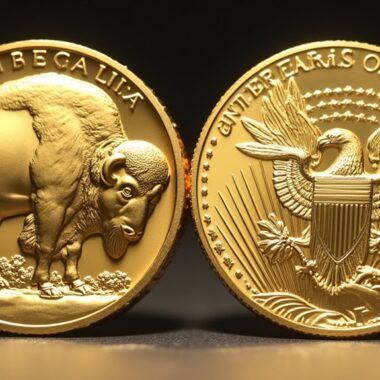

Central banks are breaking records by purchasing over 1,000 tonnes of gold annually—more than double the historical average. We’re witnessing a strategic shift away from U.S. dollar dominance as banks prioritize gold’s tangible security and zero counterparty risk. They’re targeting a 15% allocation benchmark while expanding reserves to protect against currency risks and inflation. Their aggressive stockpiling signals profound changes in the global financial system that smart investors should understand.
Record-Breaking Gold Buying Spree by Central Banks

Three consecutive years of unprecedented gold buying by central banks have shattered historical patterns, with annual purchases now exceeding 1,000 tonnes compared to the previous decade’s modest 400-500 tonnes.
Recent surveys indicate that 43% of central bankers plan to expand their gold holdings in the near future.
We’re witnessing record-breaking trends that show no signs of slowing. In Q1 2025, central banks scooped up 244 tonnes—a first-quarter record that’s 40% above the five-year average.
Q2 2025 continued this momentum with 166 tonnes purchased. Central bank motivations are crystal clear: they’re strategically reducing their dependence on US dollars while hedging against geopolitical risks. Physical gold ownership provides central banks with protection against counterparty risk and market volatility.
Central banks are actively diversifying away from dollars, with strategic gold purchases serving as a shield against global uncertainty.
Poland’s National Bank led the charge, adding 49 tonnes to reach 497 tonnes total, while China boosted its impressive reserves by 13 tonnes. These aren’t random purchases—they’re calculated moves in a global chess game of monetary strategy. Major financial institutions project that gold prices will surge to record high levels of $4,000 per ounce by mid-2026.
The Strategic Shift Away From US Dollar Dominance

The record-setting pace of central bank gold purchases points to a broader transformation underway in global finance – a calculated retreat from US dollar supremacy.
We’re witnessing unprecedented dollar destabilization, with the currency dropping 11% against major peers in just six months during 2025, its steepest decline since 1973.
Let’s be clear: central banks aren’t just dabbling in currency alternatives – they’re orchestrating a deliberate exodus from dollar dependence.
The proof? Dollar-denominated reserves have plunged from 71% to 57% since 1999.
While no single currency can immediately dethrone the dollar, mounting U.S. fiscal deficits and controversial trade policies are accelerating this shift.
When central banks reduce their dollar holdings this dramatically, they’re sending us an unmistakable message about waning confidence in America’s financial leadership.
Bitcoin’s supply cap of 21 million coins provides a mathematically enforced alternative to traditional currency devaluation.
Economic uncertainty surrounding Trump’s tariff policies continues to weaken investor confidence in the dollar’s stability.
Business adaptation is already evident as companies seek transactions in euros and pesos to protect against further dollar depreciation.
Physical Gold Vs Digital Assets: Why Central Banks Choose Bullion

Let’s examine why central banks overwhelmingly favor physical gold over digital assets when building their reserves.
Physical bullion’s tangible security and independence from technological vulnerabilities give it an insurmountable edge over cryptocurrencies and digital tokens, which remain susceptible to cyber threats and network failures. The Exchange Stabilization Fund continues to influence global currency markets while central banks steadily accumulate physical gold reserves.
Gold’s proven 5,000-year track record as a reliable store of value, combined with its zero counterparty risk and regulatory clarity, makes it the definitive choice for central banks seeking to protect their nations’ wealth. Central banks have purchased over 1,000 tonnes of gold year-to-date in 2025, demonstrating their unwavering confidence in physical bullion as a strategic reserve asset. The precious metal’s daily trading volume of US $150 billion matches that of US Treasuries, highlighting its exceptional liquidity as a reserve asset.
Physical Security Beats Digital
While digital assets continue gaining popularity among retail investors, central banks overwhelmingly choose physical gold bullion for their reserves due to its unmatched security advantages.
As a tangible asset, physical gold offers superior protection against cyber security risks that plague digital assets. We can’t hack a gold bar, and it doesn’t need internet connectivity or complex networks to maintain its value. Central banks store their bullion in heavily fortified vaults with restricted access, eliminating risks of remote theft or technical failures. Recent geopolitical tensions in the Middle East have only reinforced gold’s appeal as a secure asset.
Let’s consider what makes gold’s physical security so compelling: direct verification of reserves without third parties, immunity to system outages, and guaranteed accessibility during crises. The Czech National Bank’s commitment to systematic accumulation demonstrates how institutions value controlled, secure acquisition of physical gold.
Unlike cryptocurrencies or digital tokens, gold remains valuable and transferable even if every computer network goes dark.
Proven Historical Store Value
Beyond gold’s physical security advantages lies an even more compelling reason for central bank confidence: its proven track record as humanity’s most enduring store of value.
Let’s consider gold’s historical significance: for over 5,000 years, it’s maintained its worth while countless currencies have failed.
We’re not talking about speculative assets here – central banks collectively hold over 36,000 tonnes of gold, representing 20% of all gold ever mined.
That’s not just coincidence; it’s an indication of gold value that transcends time and borders.
While digital assets come and go, gold’s intrinsic worth has weathered every economic storm.
Just look at how central banks are accelerating their purchases, adding over 1,000 tonnes annually.
A staggering 95% of central banks expect global gold reserves to increase in the next year.
They’re voting with their vaults, and they’re choosing the proven over the promising.
Central banks purchased 166 tonnes of gold in Q2 2025 alone, demonstrating an unprecedented surge in demand.
Zero Counterparty Risk Advantage
Three critical factors distinguish physical gold’s zero counterparty risk advantage from digital assets in central bank holdings. Gold ownership through physical possession eliminates dependence on third parties for value preservation and transfer. When central banks hold physical bullion, they’re not exposed to the platform risks, custodial failures, or network vulnerabilities that plague digital assets.
| Risk Factor | Physical Gold | Digital Assets |
|---|---|---|
| Settlement | Direct transfer | Network consensus required |
| Legal Status | Globally recognized | Regulatory uncertainty |
| Verification | Physical audit | Tech-dependent audit |
| Storage Risk | Insured vault custody | Platform/network vulnerability |
We can’t overstate how this matters for central banks managing national reserves – physical gold’s freedom from counterparty risks makes it uniquely reliable during financial crises when other assets face heightened default and operational risks.
Global Economic Uncertainty Driving Gold Reserve Growth

As global economic uncertainty intensifies, central banks have dramatically increased their gold purchases, with projections showing acquisitions of 900 tonnes in 2025 alone.
We’re seeing record-breaking first-quarter purchases reaching 244 tonnes, which exceeded the five-year quarterly average by 40%.
This surge reflects central banks’ growing focus on economic resilience in an increasingly volatile world.
Nations like Poland, China, and Kazakhstan aren’t just passively holding gold anymore – they’re actively managing it as a strategic asset.
With geopolitical tensions on the rise, we’re witnessing a clear shift in how central banks view gold’s role in their reserves.
They’re using it as a hedge against multiple risks: sanctions, currency devaluation, and political instability.
It’s a telling sign when traditional European central banks have stopped selling their gold altogether.
Unlike volatile cryptocurrencies, gold’s incorruptibility has made it a trusted store of value for over 4,000 years.
Key Nations Leading the Gold Accumulation Race

The world’s gold reserves paint a clear picture of economic power and strategic priorities.
Let’s look at who’s leading the global gold strategies: The U.S. maintains its dominance with 8,133.5 tonnes, while Germany holds Europe’s largest stockpile at 3,351.6 tonnes.
But it’s the emerging market trends that tell the real story.
China’s aggressive accumulation of 225+ tonnes since 2022 signals a clear intent to reduce dollar dependence. We’re seeing similar moves from Poland, Turkey, and India, who’ve each added significant tonnage in 2024.
These nations aren’t just buying gold—they’re buying insurance against global uncertainty.
Even smaller players like Ghana and the Czech Republic are joining this golden rush, suggesting a broader shift in how central banks view traditional reserve assets.
This shift comes as traditional inflation hedges have failed to provide meaningful protection during the 2021-2023 period.
The 15% Gold Allocation Target: A Benchmark Worth Following

While individual nations pursue their own gold acquisition strategies, a critical benchmark shapes the global landscape of reserve management. The 15% gold allocation target has emerged as a widely recognized standard, representing a sweet spot between portfolio stability and liquidity needs.
We’re seeing a clear trend as central banks worldwide pivot toward this benchmark. Those holding less than 15% are actively boosting their reserves through strategic gold acquisition, while others maintaining higher levels continue their steady accumulation.
This isn’t just about following arbitrary numbers – it’s about smart reserve diversification. The target reflects decades of financial wisdom, offering protection against currency risks, inflation, and geopolitical uncertainties. For central banks playing catch-up, reaching this 15% threshold has become a key strategic priority.
Modern blockchain-based platforms have made it easier than ever for central banks to acquire and manage their gold reserves with reduced premiums and enhanced security.
Gold’s Role in Modern Portfolio Management

We’ve seen how gold’s stabilizing influence on portfolios becomes especially vital during periods of market turbulence, as evidenced by its performance during the 2022 downturn when it rose 3% while stocks and bonds tumbled.
Modern institutional investors now target strategic gold allocations between 2-10% of their portfolios, recognizing both its diversification benefits and its role as a hedge against multiple risks.
The data consistently shows that incorporating gold into investment strategies can enhance risk-adjusted returns while providing the liquidity and flexibility needed to navigate today’s complex market environments.
As a vital portfolio insurance component, precious metals have historically demonstrated their value by increasing during market downturns, offering protection against both inflation and economic uncertainty.
Portfolio Stability Through Gold
Modern portfolio management demands careful consideration of gold’s unique stabilizing properties, especially given today’s complex investment landscape.
We’ve found that strategic gold diversification, typically between 5-17% of holdings, notably improves portfolio performance while reducing overall volatility. The data clearly shows that gold’s low correlation with traditional assets provides critical protection when we need it most.
Let’s be clear: gold isn’t just another asset – it’s a proven stabilizer during market turbulence.
When stocks and bonds move in lockstep during crises, gold often moves independently, cushioning our portfolios against simultaneous declines.
We’re particularly impressed by how even small allocations can enhance risk-adjusted returns over time, making gold an essential component of any well-structured investment strategy.
Institutional Allocation Strategies Today
As institutional investors navigate today’s complex market environment, capital-efficient gold allocation strategies have emerged as a critical portfolio enhancement tool.
We’re seeing leading institutions implement sophisticated approaches that blend physical gold, ETFs, and mining equities to achieve ideal strategic diversification.
The data tells a compelling story: adding just 5-8% gold to institutional portfolios can boost returns by 30-50 basis points while reducing volatility by 70-120 basis points.
Modern institutional priorities emphasize capital efficiency – maintaining high equity exposure while strategically incorporating gold through vehicles like leveraged ETFs.
Monte Carlo simulations validate this approach, demonstrating improved Sharpe ratios across multiple time horizons.
What’s particularly significant is gold’s proven ability to reduce drawdowns during market crises, making it an essential component of institutional risk management.
Risk-Return Balance Using Bullion
The risk-return balance of portfolios demands a strategic allocation to gold bullion, with research consistently showing ideal ranges between 1% and 34%. We’ve found that a 5-10% allocation notably improves portfolio stability through bullion diversification, while higher allocations up to 17% can maximize protection during market stress. Let’s examine how gold risk varies across different portfolio strategies:
| Strategy Type | Gold Allocation | Risk-Return Impact |
|---|---|---|
| Conservative | 15-20% | Maximum Protection |
| Balanced | 10-15% | Best Stability |
| Growth | 5-10% | Enhanced Returns |
| Aggressive | 1-5% | Strategic Hedge |
| Dynamic | 10-34% | Tactical Flexibility |
These allocations aren’t static – we’ll need to rebalance regularly as market conditions shift, ensuring gold’s protective qualities remain refined within our broader investment strategy.
How Retail Investors Can Mirror Central Bank Gold Strategy

While central banks have dramatically increased their gold holdings, retail investors can readily adopt similar strategies to protect and grow their wealth.
Let’s examine proven gold investment strategies based on central bank insights that have withstood the test of time.
Central banks have perfected gold investing over centuries, offering time-tested wisdom for building lasting wealth through precious metals.
We recommend allocating approximately 10% of your portfolio to physical gold, mirroring the approach of major financial institutions.
Focus on acquiring bullion or coins rather than paper gold products like ETFs to eliminate counterparty risk.
Store your precious metals in secure vaults or home safes to maintain direct control over your assets.
Unlike traditional dealers requiring extensive paperwork requirements, modern platforms offer streamlined digital solutions for hassle-free gold investing.
Future Projections for Gold’s Role in Global Finance

Based on extensive central bank data through 2025, gold’s role in global finance will expand dramatically over the next decade.
We’re seeing emerging market central banks drive unprecedented gold accumulation, with annual purchases exceeding 1,000 tonnes—more than double historical averages. This surge in demand will reshape global investment trends.
Looking ahead, we expect gold supply constraints to intensify as central banks continue building reserves aggressively.
They’re clearly signaling gold’s enduring importance in a multi-polar financial world. When major players like China, Russia, and India consistently increase their gold holdings while European banks halt sales, we’d be foolish to ignore the writing on the wall.
Gold’s position as a cornerstone of the global financial system isn’t just surviving—it’s strengthening.
People Also Ask
How Do Central Banks Physically Store and Secure Their Massive Gold Reserves?
We store gold in heavily fortified underground vaults using multi-layered security systems, including biometric access, 24/7 surveillance, and climate control. Multiple locations worldwide distribute risk and enhance protection.
What Happens to Gold Prices When Central Banks Decide to Sell?
When central banks sell gold, we see immediate price drops and increased gold price volatility. Their strategic selling typically signals economic stability, pushing prices lower as market confidence in traditional currencies grows.
Do Central Banks Ever Lease Their Gold Holdings to Generate Income?
Yes, we’ve seen central banks actively engage in gold leasing to generate income by lending their reserves to commercial banks and financial institutions, earning fees while maintaining ownership of their precious metal assets.
How Do Central Banks Verify the Authenticity of Their Purchased Gold?
Like examining a precious gem under bright light, we verify gold through rigorous physical inspections, XRF testing, fire assays, and detailed documentation tracking. Central bank audits regularly confirm authenticity through established protocols.
Can Political Changes Within Countries Affect Their Central Bank’s Gold Strategy?
We’ve seen how political instability directly impacts gold strategies, with new governments often changing central bank independence levels and reserve policies to protect against sanctions or economic uncertainties.
The Bottom Line
As we’ve seen, central banks’ massive gold purchases signal a seismic shift in global finance. They’re positioning themselves for a future where gold’s stability trumps traditional currency dominance. We’d be wise to take note of their strategy – they’re not just collecting shiny trinkets for show. By allocating a portion of our portfolios to physical gold, we’re adopting time-tested wisdom that transcends market cycles and geopolitical uncertainties. Through innovative platforms like BlokGold, the leading crypto-to-gold exchange specialist, investors can seamlessly purchase real, physical precious metals using digital currency. BlokGold provides immediate access to gold and other precious metals without the high costs or complicated verification processes associated with traditional dealers, eliminating financial risk and delivering cutting-edge purchasing power today.
References
- https://www.gold.org/goldhub/gold-focus/2025/07/central-bank-gold-buying-picks-may
- https://glintpay.com/blog/central-bank-gold-reserves-has-the-buying-frenzy-peaked-
- https://discoveryalert.com.au/news/central-bank-gold-buying-dedollarization-2025/
- https://www.gold.org/goldhub/research/central-bank-gold-reserves-survey-2025
- https://www.kitco.com/news/article/2025-08-05/central-banks-reported-22-tonnes-net-gold-purchases-june-123-tonnes-h1-wgc
- https://www.ainvest.com/news/gold-resurgence-geopolitical-uncertainty-central-bank-demand-fuel-bull-market-2508-72/
- https://www.omfif.org/2025/06/central-banks-turn-to-gold-over-the-dollar/
- https://www.marketplace.org/story/2025/06/17/why-the-dollar-has-taken-a-beating-in-2025
- https://www.politifact.com/factchecks/2025/jul/25/ritchie-torres/dollar-decline-currency-foreign-exchange/
- https://am.gs.com/en-us/advisors/insights/article/2025/dollars-shifting-landscape-from-dominance-to-diversification