
Global central banks are abandoning the U.S. dollar at an unprecedented rate, driving gold to record highs of $3,500 per ounce in 2025. We’re seeing them purchase over 1,000 tonnes of gold annually while slashing dollar holdings by 73%. This shift reflects growing concerns about U.S. debt, inflation, and geopolitical tensions. China, India, and Poland lead the charge, as emerging markets now account for 65% of physical gold consumption. The deeper story behind this monetary revolution will surprise you.
Record Central Bank Gold Purchases Signal Dollar’s Decline

While global financial markets continue to face uncertainty, central banks’ unprecedented gold purchases tell us an unmistakable story about the dollar’s diminishing role in the international monetary system.
We’re witnessing a seismic shift in reserve strategies, with central banks adding over 1,000 tonnes annually for three straight years – double the previous decade’s average.
Let’s look at the numbers: 95% of central bankers expect gold reserves to keep climbing, while 73% plan to reduce their dollar holdings.
The National Bank of Kazakhstan led purchases with 7 tonnes in May, highlighting the growing momentum of this trend.
With daily trading volume matching that of US Treasuries, gold’s exceptional liquidity makes it an increasingly attractive alternative to traditional reserve assets.
There’s no subtlety here – gold demand from official sectors now represents 17% of global demand. Countries like Kazakhstan, Turkey, and Poland are leading this charge, adding substantial tonnage monthly. Active management of gold reserves has increased significantly from 37% to 44% in 2025.
When 76% of central banks project higher gold allocations over five years, we’d be foolish to ignore this clear vote of no confidence in the dollar.
The Strategy Behind Gold Reserve Accumulation

Three key strategies drive central banks’ historic gold accumulation: diversification, hedging against uncertainty, and long-term reserve management.
We’re witnessing unprecedented investment trends as central banks purchased over 1,000 tonnes annually for three consecutive years – more than double the previous decade’s average.
Their monetary policy shifts reflect growing concerns about inflation, U.S. debt approaching $35 trillion, and escalating trade tensions. Recent surveys indicate that geopolitical concerns are influencing investment decisions for nearly all reserve managers.
What’s particularly telling is that 95% of central banks expect global gold reserves to increase, with zero predicting decreases.
The strategy isn’t just about protecting assets – it’s about preparing for structural changes in the global financial system. Emerging market and developing economies have shown a strong gold preference compared to advanced economies.
Central banks are positioning themselves for a fundamental shift in global finance, moving beyond mere wealth preservation.
We’ve noticed significant reporting gaps too, suggesting actual purchases may be even higher than official figures indicate.
The dramatic surge to record price peaks of $3,778 by September 2025 validates central banks’ strategic shift toward gold reserves.
Major Nations Leading the Gold Rush

As central banks worldwide rush to secure their financial futures, several nations have emerged as clear frontrunners in the unprecedented gold acquisition race of 2024-2025.
Poland’s expansion leads the pack with an impressive 89.54 tonnes added, while Turkey’s strategy netted 74.79 tonnes in systematic purchases.
Central banks have purchased nearly 1 in 8 ounces of global gold mine production over the past five years.
We’re seeing China’s moderation in action as they’ve scaled back from previous years but maintain steady accumulation, adding 44.17 tonnes in 2024.
India’s growth remains robust with 72.6 tonnes acquired, reflecting both cultural and strategic priorities.
In emerging markets, Kazakhstan and Uzbekistan have shown surprising aggression, with Kazakhstan adding 7 tonnes in May 2025 alone.
These nations aren’t just buying gold – they’re rewriting the rules of reserve management.
The latest data is compiled and released within 10 days of each month’s end, ensuring transparency in global reserve movements.
Dollar Reserve Share Hits Historic Low

Despite maintaining its position as the world’s dominant reserve currency, the US dollar’s share of global foreign exchange reserves has plummeted to 57.74% – a level we haven’t seen since 1995.
The Bretton Woods Agreement established this American monetary dominance back in 1944 when 44 nations made the dollar their primary reserve currency.
The latest data shows the Euro holdings share increased to 20.06% from 19.84%.
We’re witnessing a remarkable shift in reserve competition as central banks diversify their portfolios into alternative currencies and gold. Physical asset diversification has proven crucial for preserving wealth during periods of monetary instability.
Let’s be clear: this dollar depreciation isn’t benefiting a single challenger.
Instead, we’re seeing smaller currencies like the Canadian dollar and Australian dollar gaining ground, while gold now accounts for 15% of global reserve assets.
When we factor in gold’s market value, the dollar’s actual share drops even further to 48.2%.
Gold Price Surge and Market Projections

While central banks scramble to diversify their reserves, gold’s meteoric rise has shattered previous records, reaching an unprecedented $3,500.05 per troy ounce in April 2025.
We’re witnessing a remarkable 29% surge since January, with gold now trading at $3,348.50 – and that’s likely just the beginning.
Leading institutions paint an ambitious future for the yellow metal. We’re looking at projections ranging from HSBC’s conservative $3,215 average to InvestingHaven’s bullish $4,200 target for 2026.
Gold demand remains robust despite price volatility, particularly from central banks who strategically increase purchases during dips toward $3,000. The latest data shows gold reaching a current price of $3,782.10 per ounce, marking significant gains in the precious metals market. Central bank holdings have reached a historic milestone of 36,200 tonnes of gold reserves. Traditional inflation hedges like Treasury bonds have proven ineffective, driving investors toward precious metals as a safer store of value.
Long-term forecasts are even more striking, with several analysts predicting $5,000+ by 2027.
Let’s face it – in today’s uncertain climate, gold’s appeal as a safe-haven asset shows no signs of dimming.
Geopolitical Tensions Fuel De-dollarization

The Trump administration’s aggressive trade policies have sparked an unprecedented exodus from the US dollar.
We’re witnessing major geopolitical shifts as BRICS nations, now representing 42% of global GDP, lead the charge toward currency alternatives.
The dollar’s weaponization through tariffs and sanctions has backfired spectacularly.
Central banks aren’t just diversifying – they’re fleeing.
The dollar’s share of global reserves has plummeted to 57.74%, while emerging markets embrace gold and alternative currencies.
Deutsche Bank’s warning of “unchartered territory” in global finance tells us everything we need to know.
The rise of BRICS, coupled with China’s economic reforms, has created a perfect storm for de-dollarization.
Who’d have thought that threatening 100% tariffs would actually accelerate the dollar’s decline?
The mounting pressure on reserves has led to a 149 million ounce deficit in the silver market despite record production levels.
Emerging Markets Drive Gold Demand
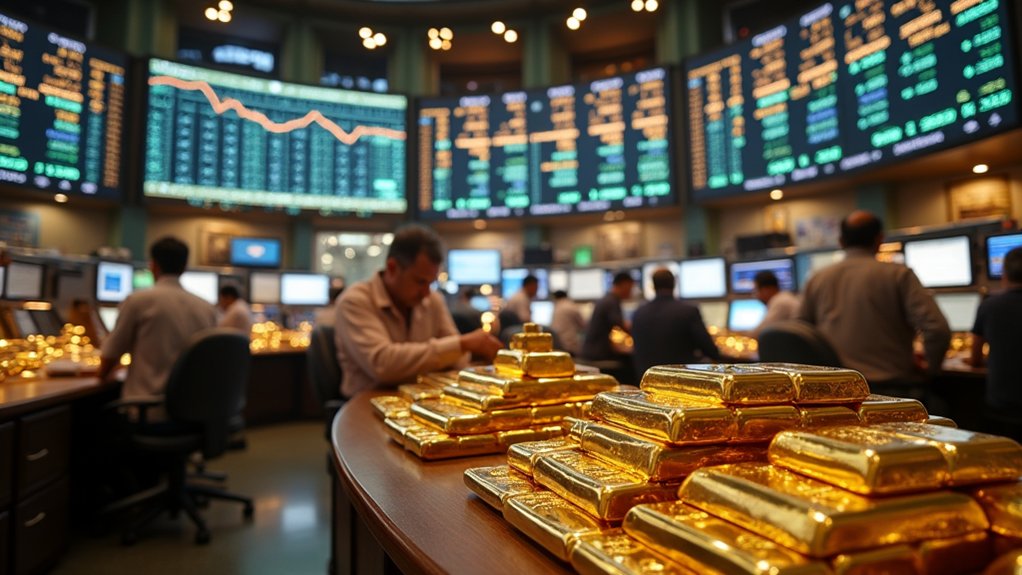
We’re seeing emerging markets become the dominant force in global gold demand, with the BRICS nations leading an unprecedented wave of central bank purchases.
These developing economies now control over 65% of physical gold consumption, marking a dramatic power shift from traditional Western markets to Asia-Pacific and other emerging regions.
As wealth accumulation accelerates across these markets, their growing appetite for gold reflects both strategic diversification away from the dollar and deeply-rooted cultural preferences for precious metals as stores of value.
This shift toward gold aligns with projections showing gold prices reaching $5,150 by 2030 as emerging markets continue prioritizing its safe-haven status.
Strategic Reserve Diversification
Three major forces have converged to drive emerging market central banks’ unprecedented gold accumulation since 2024.
As reserve strategy shifts away from dollar dependence, we’re seeing central banks capitalize on gold’s unique diversification benefits through increased allocations. The data reveals ideal gold positions between 8.4% and 10% when measured in local emerging market currencies – nearly double current levels.
- Statistical analysis confirms gold’s negative correlation to the US dollar enhances portfolio stability
- Deteriorating credit quality of sovereign debt pushes central banks toward zero-risk gold holdings
- Gold’s consistent volatility across currencies provides superior risk management compared to traditional reserves
These structural changes have transformed central bank reserve management, contributing to gold’s explosive price appreciation beyond $3,500/oz in 2025.
BRICS Nations Lead Purchases
Building on these shifting reserve strategies, BRICS nations have emerged as the dominant force driving global gold demand in 2025.
We’re witnessing an unprecedented expansion of BRICS partnerships, with the alliance growing from 5 to 10 full members while adding 8 partner nations. Their coordinated gold strategies are reshaping global markets, as evidenced by the 41% surge in central bank purchases during Q2 2025.
Let’s examine the numbers: Russia maintains 2,300 tons in reserves, China holds over 2,000 tons, and India continues steady accumulation.
These powerhouse economies aren’t just hoarding gold – they’re systematically positioning themselves for the launch of a new BRICS currency in 2026. Combined with their alternative payment systems that bypass the dollar, we’re seeing the framework for a new financial order taking shape.
Regional Economic Power Shift
While BRICS nations maintain their influence, the broader shift in economic power toward emerging markets has fundamentally transformed global gold dynamics.
We’re witnessing an unprecedented regional power realignment as Asia-Pacific captures 65% of global gold demand, with China and India leading the charge at 50% combined.
This economic change reflects the stark reality that emerging markets have grown at 4.5% annually while advanced economies lag at just 1.8%.
- Asia’s expanding middle class wields newfound financial sophistication, merging cultural gold traditions with modern investment strategies.
- Currency weakness and domestic market uncertainty drive sustained investment flows, particularly in China and India.
- Central bank purchases from emerging economies reinforce retail demand patterns, creating a self-reinforcing cycle of regional gold accumulation.
Portfolio Diversification in a Volatile World

In an era of unprecedented market volatility, traditional portfolio diversification strategies no longer provide the safety net investors once relied upon.
The breakdown of negative stock-bond correlations has fundamentally altered how we must approach asset allocation and risk management.
We’re seeing a dramatic shift in portfolio construction as traditional relationships between asset classes evolve.
Smart investors are now looking beyond the classic 60/40 stock-bond split, embracing alternatives like private credit, infrastructure, and selective emerging market exposure.
Geographic diversification has become essential – we can’t afford to maintain a U.S.-centric bias when policy uncertainties loom large.
The key is building resilient portfolios through granular diversification across uncorrelated assets.
That means combining developed and emerging market equities, alternative investments, and strategic cash positions while maintaining disciplined rebalancing protocols.
Institutional investors are increasingly adopting Bitcoin and gold as complementary assets due to their low correlation and enhanced diversification benefits.
Central Bank Survey Results Reveal Shift

Recent survey findings from the World Gold Council paint a dramatic picture of central banks’ shifting attitudes toward gold reserves.
We’re seeing unprecedented participation in their 2025 survey, with 73 central banks weighing in on their gold strategies.
The results reveal three transformative gold trends:
- A staggering 95% of central banks expect global gold reserves to increase, while none plan to reduce their holdings
- Active gold management has jumped to 44%, reflecting heightened strategic importance
- 73% of respondents plan to reduce dollar holdings in favor of gold over the next five years
We’re witnessing a seismic shift in central bank strategies, as institutions double down on gold amid geopolitical tensions and inflation concerns.
The Bank of England remains the preferred storage location, though the landscape continues to evolve.
This shift towards gold aligns with broader market dynamics, as high-net-worth investors increasingly maintain 25% of their portfolios in precious metals.
Gold’s Role in Global Reserve Management

The dramatic shift in central bank attitudes has sparked a fundamental transformation in gold’s position within the global monetary system.
We’re witnessing gold’s ascension to become the world’s second-largest reserve asset, now representing 20% of global reserves – a level we haven’t seen since the Bretton Woods era.
Central banks’ reserve strategies have evolved dramatically in response to geopolitical tensions and sanctions risks.
They’re turning to gold because it offers something unique: true neutrality in an increasingly divided world.
The metal’s recent gold valuation surge reflects this shift, with prices climbing 25% since 2020.
We’re seeing particularly aggressive accumulation from China, Turkey, and India, who recognize that gold provides both strategic flexibility and a hedge against political uncertainty in ways traditional currency reserves simply can’t match.
During periods of market volatility, gold’s low volatility of 0.5-1% daily makes it an exceptionally stable reserve asset compared to other investments.
People Also Ask
How Do Central Banks Physically Store and Secure Their Gold Reserves?
We store central bank gold in highly secure underground vaults with multiple security layers, including biometric access, 24/7 surveillance, and reinforced walls. Our facilities require dual control for vault entry.
What Happens to Domestic Currencies When Central Banks Rapidly Accumulate Gold?
When mountains of gold flood central bank vaults, we’re seeing our currencies face massive depreciation pressure. It’s pushing up inflation pressures as our domestic money loses relative value against growing reserves.
Can Individual Investors Benefit From Following Central Bank Gold Strategies?
We can mirror central banks’ gold investing approach by allocating 5-10% to gold through ETFs or bullion, gaining similar risk management benefits and portfolio protection during economic uncertainty.
How Do Central Banks Verify the Authenticity of Their Gold Purchases?
We verify, inspect, and test using multiple gold authentication methods. Central bank audits combine physical checks, advanced scientific analysis, professional certifications, and strict quality control processes for absolute certainty.
Which Countries Have Historically Sold the Most Gold Reserves and Why?
We’ve seen major gold selling from European central banks, particularly the Netherlands and Switzerland, as their reserve strategies shifted away from gold toward diversified portfolios during the 1990s and 2000s.
The Bottom Line
We’re witnessing a seismic shift in global finance as central banks ditch the greenback faster than trading cards at recess. Our analysis shows gold’s meteoric rise isn’t just another market cycle – it’s a fundamental restructuring of monetary power. The evidence is clear: record gold purchases, plummeting dollar reserves, and emerging market demand signal a new financial order.
Smart investors looking to position themselves for 2025’s golden renaissance would be wise to explore BlokGold, the leading crypto precious metals exchange specialist. BlokGold allows you to buy real physical precious metals like gold and silver directly using cryptocurrency, eliminating the need for expensive traditional dealers. With BlokGold, you can access cutting-edge precious metals purchasing today rather than waiting for future market opportunities, helping mitigate financial risk. Visit BlokGold.com to start your precious metals journey today.
References
- https://www.gold.org/goldhub/research/central-bank-gold-reserves-survey-2025
- https://www.gold.org/goldhub/gold-focus/2025/07/central-bank-gold-buying-picks-may
- https://timesofindia.indiatimes.com/business/india-business/betting-on-gold-central-banks-around-the-world-to-continue-buying-gold-this-year-holdings-to-see-big-increase/articleshow/121907785.cms
- https://www.kitco.com/news/article/2025-08-05/central-banks-reported-22-tonnes-net-gold-purchases-june-123-tonnes-h1-wgc
- https://www.ainvest.com/news/gold-resurgence-geopolitical-uncertainty-central-bank-demand-fuel-bull-market-2508-58/
- https://www.ecb.europa.eu/press/other-publications/ire/focus/html/ecb.irebox202506_01~f93400a4aa.en.html
- https://blogs.worldbank.org/en/opendata/gold-shines-amid-uncertainty
- https://discoveryalert.com.au/news/central-bank-gold-buying-2025-reserve-strategy/
- https://discoveryalert.com.au/news/central-banks-buying-gold-2025-motivation-trends/
- https://www.jpmorgan.com/insights/global-research/commodities/gold-prices