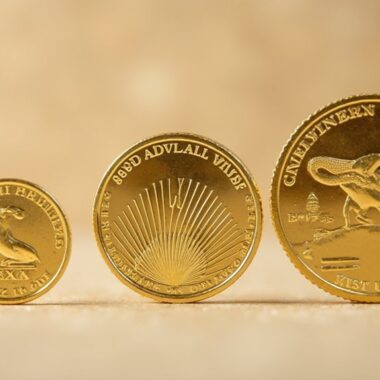

We’re comparing two U.S. Mint gold coins that look similar but differ markedly. The Gold Eagle (1986) contains 22-karat gold with alloy metals for durability, while the Gold Buffalo (2006) is pure 24-karat gold. Both hold one troy ounce of gold, but the Buffalo commands higher premiums due to purity preferences, though Eagles offer fractional denominations for flexible investing. Their distinct designs reflect different American values—Liberty versus Native American heritage. Understanding how composition affects durability, liquidity, and portfolio strategy reveals why savvy investors often consider both.
Two Different US Mint Gold Coins Explained

The United States Mint produces two distinct gold bullion coins that’ve captured investors’ and collectors’ attention for decades, each offering its own unique appeal.
We’re looking at the American Gold Eagle, introduced in 1986, and the American Gold Buffalo, launched in 2006. While both coins contain exactly one troy ounce of gold and carry a $50 face value, they differ markedly in composition and design.
The Eagle combines 22-karat gold with silver and copper for enhanced durability, whereas the Buffalo showcases 24-karat pure gold. Understanding these distinctions helps us navigate investment trends and anticipate market fluctuations.
Each coin serves different investor priorities—whether you’re seeking maximum purity or preferred fractional options for portfolio diversification. Like other brilliant uncirculated gold coins, both the Eagle and Buffalo maintain their value through their composition, condition, and limited availability in the precious metals market.
Purity Difference: 22K Eagle Vs 24K Buffalo

When we examine what’s actually inside these two iconic coins, we’re looking at a fundamental difference that shapes everything else about them—purity.
The Gold Eagle contains 22-karat gold (91.67% pure), mixed with silver and copper for durability. The Gold Buffalo, however, is 24-karat (99.99% pure gold).
Gold Eagle’s 22-karat composition offers durability, while Gold Buffalo’s 24-karat purity delivers maximum gold content.
Here’s what this means for you:
- Eagle weighs 33.930g but contains only one troy ounce of pure gold
- Buffalo weighs 31.103g and contains exactly one troy ounce of pure gold
- Higher purity creates stronger collector appeal and market trends favoring Buffalos
- Alloy composition reduces investment risks for Eagles through increased hardness
The Eagle’s copper content gives it a rosy hue and superior durability.
Buffalo’s purity attracts investors seeking maximum gold content, though both coins guarantee their troy ounce weight. Like the Britannia Gold Coin, which achieves 99.99% purity, the Buffalo’s ultra-pure composition appeals to serious precious metal investors. Similar to other brilliant uncirculated coins, the Buffalo maintains exceptional quality standards that enhance its desirability among collectors.
When we examine what’s actually inside these two iconic coins, we’re looking at a fundamental difference that shapes everything else about them—purity.
The Gold Eagle contains 22-karat gold (91.67% pure), mixed with silver and copper for durability. The Gold Buffalo, however, is 24-karat (99.99% pure gold).
Gold Eagle’s 22-karat composition offers durability, while Gold Buffalo’s 24-karat purity delivers maximum gold content.
Here’s what this means for you:
- Eagle weighs 33.930g but contains only one troy ounce of pure gold
- Buffalo weighs 31.103g and contains exactly one troy ounce of pure gold
- Higher purity creates stronger collector appeal and market trends favoring Buffalos
- Alloy composition reduces investment risks for Eagles through increased hardness
The Eagle’s copper content gives it a rosy hue and superior durability.
Buffalo’s purity attracts investors seeking maximum gold content, though both coins guarantee their troy ounce weight. Like the Britannia Gold Coin, which achieves 99.99% purity, the Buffalo’s ultra-pure composition appeals to serious precious metal investors. Similar to other brilliant uncirculated coins, the Buffalo maintains exceptional quality standards that enhance its desirability among collectors.
Historical Background: Why Two Different Coins Exist

Back in 1986, Congress authorized the American Gold Eagle through Public Law 99-185, establishing what’d become the nation’s official gold bullion coin—a role it filled without competition for two decades.
Then came 2006, when Public Law 109-145 introduced the American Gold Buffalo, marking a significant shift in U.S. Mint strategy. We now had two distinct coins serving different market segments.
The Buffalo’s creation reflected growing investor demand for maximum purity bullion, while the Eagle maintained its position as the established standard. Like the Britannia series from the Royal Mint, both American coins are produced in brilliant uncirculated condition to appeal to discerning collectors. The Buffalo’s 99.99% gold content represents the highest quality purity rating available in modern bullion production.
This legislative impact created a fascinating dynamic: collectors could choose between the Eagle’s proven track record and durability or the Buffalo’s pure gold appeal.
Both coins coexist today, each with distinct historical significance within America’s precious metals program. Like other investment-grade gold products from various mints worldwide, both American coins appeal to investors seeking tangible assets with enduring value.
Back in 1986, Congress authorized the American Gold Eagle through Public Law 99-185, establishing what’d become the nation’s official gold bullion coin—a role it filled without competition for two decades.
Then came 2006, when Public Law 109-145 introduced the American Gold Buffalo, marking a significant shift in U.S. Mint strategy. We now had two distinct coins serving different market segments.
The Buffalo’s creation reflected growing investor demand for maximum purity bullion, while the Eagle maintained its position as the established standard. Like the Britannia series from the Royal Mint, both American coins are produced in brilliant uncirculated condition to appeal to discerning collectors. The Buffalo’s 99.99% gold content represents the highest quality purity rating available in modern bullion production.
This legislative impact created a fascinating dynamic: collectors could choose between the Eagle’s proven track record and durability or the Buffalo’s pure gold appeal.
Both coins coexist today, each with distinct historical significance within America’s precious metals program. Like other investment-grade gold products from various mints worldwide, both American coins appeal to investors seeking tangible assets with enduring value.
Design Comparison: Lady Liberty Vs Buffalo/Native American

Symbolism’s power lies in how it shapes our connection to physical objects, and nowhere is this more evident than in comparing the visual narratives etched onto these two iconic coins.
The artistic depiction on each tells distinctly American stories through contrasting imagery. Here’s what separates them:
- Gold Eagle’s Lady Liberty – Augustus Saint-Gaudens’ elegant design symbolizes freedom and national ideals
- Buffalo’s Native American – James Earle Fraser’s profile honors America’s indigenous heritage
- Reverse symbolism – Eagles represent liberty and strength; bison embody the American frontier
- Cultural narratives – One celebrates classical American values, while the other acknowledges westward expansion
We’re looking at design symbolism that reflects different eras of American identity. The Eagle emphasizes timeless liberty, whereas the Buffalo grounds us in the nation’s complex territorial history. Like other globally treasured coins such as the Mexican Libertad, American gold coins are struck using special dies to create distinctive artistic impressions. Collector’s coins featuring pure silver content of 99.9% demonstrate similar commitment to authenticity and quality across different precious metal offerings.
Both coins celebrate America, just from different perspectives. These coins serve as investment grade assets, appealing to collectors who value both aesthetic merit and precious metal content.
Symbolism’s power lies in how it shapes our connection to physical objects, and nowhere is this more evident than in comparing the visual narratives etched onto these two iconic coins.
The artistic depiction on each tells distinctly American stories through contrasting imagery. Here’s what separates them:
- Gold Eagle’s Lady Liberty – Augustus Saint-Gaudens’ elegant design symbolizes freedom and national ideals
- Buffalo’s Native American – James Earle Fraser’s profile honors America’s indigenous heritage
- Reverse symbolism – Eagles represent liberty and strength; bison embody the American frontier
- Cultural narratives – One celebrates classical American values, while the other acknowledges westward expansion
We’re looking at design symbolism that reflects different eras of American identity. The Eagle emphasizes timeless liberty, whereas the Buffalo grounds us in the nation’s complex territorial history. Like other globally treasured coins such as the Mexican Libertad, American gold coins are struck using special dies to create distinctive artistic impressions. Collector’s coins featuring pure silver content of 99.9% demonstrate similar commitment to authenticity and quality across different precious metal offerings.
Both coins celebrate America, just from different perspectives. These coins serve as investment grade assets, appealing to collectors who value both aesthetic merit and precious metal content.
Premium Analysis: Which Costs More and Why

Why does paying more for an ounce of gold sometimes make perfect sense? When you’re comparing premiums between these two coins, you’re really looking at what collectors and investors willingly pay beyond spot price. The Gold Buffalo commands an 8-12% premium while the Gold Eagle sits at 5-8%, a meaningful difference that reflects market trends and purity expectations. Renowned for crafting numismatic masterpieces, the Royal Canadian Mint produces premium gold coins that often command higher prices due to their exceptional quality and limited availability.
| Factor | Gold Buffalo | Gold Eagle |
|---|---|---|
| Purity | 99.99% | 91.67% |
| Premium Range | 8-12% | 5-8% |
| Primary Driver | Rarity & Purity | Liquidity |
| Collector Appeal | Higher | Moderate |
| Premium Fluctuations | More Volatile | More Stable |
That higher Buffalo premium stems from its superior purity and lower mintage. Understanding these premium fluctuations helps you make informed decisions about which coin fits your investment strategy.
Why does paying more for an ounce of gold sometimes make perfect sense? When you’re comparing premiums between these two coins, you’re really looking at what collectors and investors willingly pay beyond spot price. The Gold Buffalo commands an 8-12% premium while the Gold Eagle sits at 5-8%, a meaningful difference that reflects market trends and purity expectations. Renowned for crafting numismatic masterpieces, the Royal Canadian Mint produces premium gold coins that often command higher prices due to their exceptional quality and limited availability.
| Factor | Gold Buffalo | Gold Eagle |
|---|---|---|
| Purity | 99.99% | 91.67% |
| Premium Range | 8-12% | 5-8% |
| Primary Driver | Rarity & Purity | Liquidity |
| Collector Appeal | Higher | Moderate |
| Premium Fluctuations | More Volatile | More Stable |
That higher Buffalo premium stems from its superior purity and lower mintage. Understanding these premium fluctuations helps you make informed decisions about which coin fits your investment strategy.
Actual Gold Content: Weight Comparison

When we compare these two coins, we’re looking at a significant distinction: both contain exactly one troy ounce of gold by legal guarantee, yet their physical weights differ noticeably because of their different purity levels.
The Gold Eagle weighs 33.930 grams total (1.0909 troy ounces) due to its 22-karat composition with added silver and copper, while the Gold Buffalo tips the scale at just 31.103 grams since it’s 24-karat pure gold with minimal other metals.
Understanding this weight difference helps explain why the Buffalo sits lower in your hand despite holding the same amount of actual gold—the Eagle’s alloy additions bulk it up while delivering the exact ounce of gold you’re paying for. The American Eagle maintains a premium over its metal value, which accounts for its collectibility and investment appeal beyond the raw gold content.
Gold coins from various origins, such as the Gold Tientje from the Netherlands, demonstrate how different countries produce coins with distinct physical characteristics and purity levels that reflect their numismatic traditions.
Troy Ounce Standardization
Both the American Gold Eagle and American Gold Buffalo are guaranteed to contain exactly one troy ounce of gold, yet here’s where it gets interesting: they don’t weigh the same on a standard scale.
The troy ounce dimensions and gold weight standard explain this apparent contradiction. Here’s what we’re working with:
- Gold Eagle weighs 33.930 grams total due to its 22-karat alloy composition
- Gold Buffalo weighs 31.103 grams, containing pure 24-karat gold
- Both contain precisely one troy ounce of actual gold content
- The difference comes from added metals in the Eagle’s composition
Similar to investment-grade coins like the Australian Emu, 99.99% gold purity represents the highest standard for precious metal coins and ensures maximum intrinsic value for collectors and investors. The buyback guarantee available for premium gold products demonstrates the strong resale market confidence in these investments. Like the King George V Gold Sovereign, these coins are recognized by collectors and investors as safe-haven assets with high durability due to their gold composition.
Physical Weight Differences
Since we’re comparing two coins that contain identical amounts of gold yet tip the scales differently, it’s worth understanding exactly what’s happening beneath the surface.
The Gold Buffalo weighs 31.103 grams—precisely one troy ounce of pure gold. The Gold Eagle, however, weighs 33.930 grams because it’s only 91.67% gold; the remaining composition includes silver and copper for durability.
That 2.827-gram difference matters for gold storage calculations and investment timing decisions. When you’re purchasing these coins, you’re getting equal amounts of actual gold content, but the Eagle occupies slightly more physical space.
Understanding this distinction helps you plan vault requirements and compare true value per gram of pure gold accurately.
When we compare these two coins, we’re looking at a significant distinction: both contain exactly one troy ounce of gold by legal guarantee, yet their physical weights differ noticeably because of their different purity levels.
The Gold Eagle weighs 33.930 grams total (1.0909 troy ounces) due to its 22-karat composition with added silver and copper, while the Gold Buffalo tips the scale at just 31.103 grams since it’s 24-karat pure gold with minimal other metals.
Understanding this weight difference helps explain why the Buffalo sits lower in your hand despite holding the same amount of actual gold—the Eagle’s alloy additions bulk it up while delivering the exact ounce of gold you’re paying for. The American Eagle maintains a premium over its metal value, which accounts for its collectibility and investment appeal beyond the raw gold content.
Gold coins from various origins, such as the Gold Tientje from the Netherlands, demonstrate how different countries produce coins with distinct physical characteristics and purity levels that reflect their numismatic traditions.
Troy Ounce Standardization
Both the American Gold Eagle and American Gold Buffalo are guaranteed to contain exactly one troy ounce of gold, yet here’s where it gets interesting: they don’t weigh the same on a standard scale.
The troy ounce dimensions and gold weight standard explain this apparent contradiction. Here’s what we’re working with:
- Gold Eagle weighs 33.930 grams total due to its 22-karat alloy composition
- Gold Buffalo weighs 31.103 grams, containing pure 24-karat gold
- Both contain precisely one troy ounce of actual gold content
- The difference comes from added metals in the Eagle’s composition
Similar to investment-grade coins like the Australian Emu, 99.99% gold purity represents the highest standard for precious metal coins and ensures maximum intrinsic value for collectors and investors. The buyback guarantee available for premium gold products demonstrates the strong resale market confidence in these investments. Like the King George V Gold Sovereign, these coins are recognized by collectors and investors as safe-haven assets with high durability due to their gold composition.
Physical Weight Differences
Since we’re comparing two coins that contain identical amounts of gold yet tip the scales differently, it’s worth understanding exactly what’s happening beneath the surface.
The Gold Buffalo weighs 31.103 grams—precisely one troy ounce of pure gold. The Gold Eagle, however, weighs 33.930 grams because it’s only 91.67% gold; the remaining composition includes silver and copper for durability.
That 2.827-gram difference matters for gold storage calculations and investment timing decisions. When you’re purchasing these coins, you’re getting equal amounts of actual gold content, but the Eagle occupies slightly more physical space.
Understanding this distinction helps you plan vault requirements and compare true value per gram of pure gold accurately.
Liquidity Differences: Market Recognition and Demand

If you’re thinking about selling your gold coins quickly, you’ll notice that liquidity—how easily you can convert an asset to cash—differs markedly between these two American bullion offerings.
We find that market recognition and demand fluctuations create distinct advantages for each coin:
- Gold Eagles dominate domestic markets due to their 37-year history and established buyer networks.
- Gold Buffalos command stronger collector interest, which can stabilize demand despite lower overall volume.
- Fractional Eagle availability expands liquidity across multiple investor segments.
- Buffalo’s 24-karat purity attracts specialized buyers seeking maximum gold content.
Gold Eagles typically move faster through secondary markets because dealers stock them regularly.
Buffalo demand remains robust among purity-focused investors, though you’ll encounter fewer buyers overall.
Both coins maintain global recognition, but Eagles’ longer market presence provides that vital liquidity edge when you need quick conversion to cash.
If you’re thinking about selling your gold coins quickly, you’ll notice that liquidity—how easily you can convert an asset to cash—differs markedly between these two American bullion offerings.
We find that market recognition and demand fluctuations create distinct advantages for each coin:
- Gold Eagles dominate domestic markets due to their 37-year history and established buyer networks.
- Gold Buffalos command stronger collector interest, which can stabilize demand despite lower overall volume.
- Fractional Eagle availability expands liquidity across multiple investor segments.
- Buffalo’s 24-karat purity attracts specialized buyers seeking maximum gold content.
Gold Eagles typically move faster through secondary markets because dealers stock them regularly.
Buffalo demand remains robust among purity-focused investors, though you’ll encounter fewer buyers overall.
Both coins maintain global recognition, but Eagles’ longer market presence provides that vital liquidity edge when you need quick conversion to cash.
Available Denominations for Each Coin Series
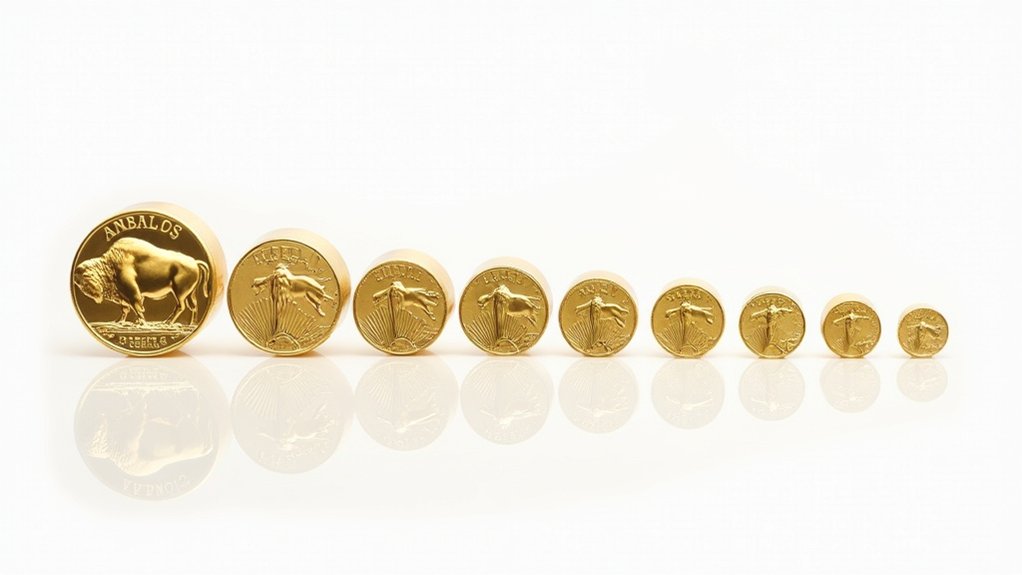
When you’re building a gold portfolio, the range of sizes available matters greatly—and that’s where these two coins diverge considerably. The Gold Eagle, introduced in 1986, offers flexibility through its minting process across four denominations, while the Gold Buffalo, launched in 2006, provides only the one-ounce bullion version regularly. This difference holds historical significance for investors with varying budget constraints.
| Coin | 1 oz | ½ oz | ¼ oz | 1/10 oz |
|---|---|---|---|---|
| Gold Eagle | ✓ | ✓ | ✓ | ✓ |
| Gold Buffalo | ✓ | ✗ | ✗ | ✗ |
The Gold Eagle’s multiple size options make fractional investing accessible, whereas the Gold Buffalo’s singular denomination appeals to those committing to full-ounce purchases. Understanding these availability differences shapes your investment strategy considerably.
Which Coin Suits Different Investment Strategies

If you’re building a fractional portfolio, Gold Eagles’ multiple denominations—1 oz, 1/2 oz, 1/4 oz, and 1/10 oz—let you scale your positions precisely and diversify across different sizes without committing to full ounces.
For purity-focused collectors who prioritize maximum gold content, Gold Buffalos’ 99.99% pure composition beats the Eagle’s 91.67% purity, though you’ll pay an 8-12% premium versus the Eagle’s 5-8% markup over spot.
Your strategy ultimately hinges on whether flexibility and lower premiums matter more to you, or whether owning the highest-purity American bullion coin justifies the higher cost.
Fractional Portfolio Building
Because we’re building gold portfolios with different goals in mind, we’ve got to recognize that the American Gold Eagle and American Gold Buffalo serve distinctly different roles in fractional investing.
The Eagle’s availability across multiple denominations—1 oz, 1/2 oz, 1/4 oz, and 1/10 oz—makes it ideal for portfolio diversification strategies requiring flexible position sizing.
Consider these key advantages:
- Fractional options enable graduated accumulation plans
- Lower premiums (5-8%) reduce entry costs for smaller investments
- Superior liquidity across all denominations facilitates portfolio rebalancing
- Durability from alloy composition withstands frequent handling during adjustments
The Buffalo, conversely, offers only 1 oz bullion availability, limiting its flexibility for fractional investing.
We’d choose Eagles when building layered portfolios requiring varied denominations and frequent adjustments.
Purity-Focused Collectors
While fractional portfolios demand flexibility across multiple denominations, a different breed of investor prioritizes what’s actually in their vault: pure gold.
We’re talking about collector preferences that lean toward maximum purity. The Gold Buffalo’s 24-karat composition appeals to these purists who value owning genuine, unadulterated gold.
This higher purity creates meaningful distinctions in value appreciation potential. When you’re holding 99.99% pure gold versus 91.67%, you’re not just splitting hairs—you’re making a statement about investment philosophy.
Purity-focused collectors recognize that the Buffalo’s composition, combined with its lower mintage and stronger collector appeal, positions it differently in the market.
They’re willing to accept the single one-ounce denomination and higher premium because they’re betting on numismatic appreciation alongside bullion value growth.
Can You Mix Both in the Same Portfolio

Many investors wonder whether combining American Gold Eagles and American Gold Buffalos in a single portfolio makes sense, and the answer isn’t as straightforward as you might think.
We’ve found that blending both coins into your gold portfolio offers genuine investment diversification benefits worth considering.
Here’s why many collectors mix them:
- Leverage fractional flexibility with Eagles while maximizing purity through Buffalos
- Balance liquidity advantages of Eagles against Buffalos’ numismatic appreciation potential
- Hedge premium fluctuations by holding both coins’ different market positions
- Create redundancy—if one coin’s demand drops, your other holdings remain stable
You’re fundamentally building a dual-strategy approach: Eagles handle accessibility and fractional needs, while Buffalos target purity-focused growth.
This combination strengthens your overall gold position without overcomplicating your holdings.
Durability and Handling: How Alloy Composition Affects Your Coins

When we handle our gold coins regularly, we’re confronted with a fundamental chemistry problem: pure gold, despite its prestige, is remarkably soft and susceptible to scratches, dents, and wear that can diminish both aesthetic appeal and resale value.
The Gold Eagle’s 22-karat composition—which blends gold with silver and copper—creates a considerably harder alloy that resists surface damage and maintains its appearance through years of handling, while the Buffalo’s 24-karat purity, though maximizing actual gold content, leaves it vulnerable to the physical stresses that come with storage and examination.
Your choice between these coins ultimately hinges on whether you prioritize maximum gold content and accept the maintenance challenges of a softer metal, or opt for the practical durability that alloy composition provides for long-term coin preservation.
Pure Gold’s Inherent Softness
Pure gold presents an intriguing paradox: it’s one of the most prized precious metals, yet it’s also surprisingly soft and vulnerable to damage.
We need to understand gold softness to appreciate why the Gold Buffalo’s 24-karat composition requires careful coin handling.
Here’s what makes pure gold challenging:
- Malleable nature allows easy scratching and denting from minor contact
- Susceptibility to wear increases greatly with frequent handling
- Surface damage becomes permanent, affecting aesthetic appeal and potential value
- Pressure points from storage or transport create visible marks
The Gold Buffalo’s near-pure composition (99.99% gold) makes it more prone to these vulnerabilities than the Gold Eagle’s 22-karat alloy.
While this purity attracts collectors seeking maximum gold content, it demands respectful storage practices.
Understanding these characteristics helps us make informed decisions about which coin best suits our investment needs and handling tolerance.
Alloy Durability For Handling
Knowing why the Gold Eagle’s 22-karat composition outperforms the Gold Buffalo’s pure gold in real-world handling situations helps us understand a fundamental trade-off in bullion investing. When we examine coin handling, alloy resilience becomes essential. The Eagle’s copper and silver additions create a harder surface that resists scratches and dents during regular contact. Meanwhile, the Buffalo’s 24-karat purity makes it more vulnerable to surface damage because pure gold is remarkably soft—a property that actually works against collectors who frequently handle their coins.
| Aspect | Gold Eagle | Gold Buffalo |
|---|---|---|
| Composition | 22K (91.67% gold) | 24K (99.99% gold) |
| Hardness | Higher | Lower |
| Scratch Resistance | Excellent | Prone to marks |
| Handling Safety | Better | Requires care |
| Long-term Durability | Superior | More delicate |
This difference matters considerably for investors who plan active coin handling.
People Also Ask
Are Both American Gold Eagle and Buffalo Coins Eligible for Retirement Accounts?
We can hold both coins in retirement accounts for investment diversification. Gold Eagles are explicitly named in U.S. law, while Buffalos qualify through IRA-eligible gold provisions, making each viable for our long-term retirement planning strategies.
What Is the Current Annual Mintage Comparison Between Gold Eagles and Buffalos?
We can tell you that Gold Eagles maintain substantially higher annual mintage trends than Gold Buffalos. The coin production statistics show Eagles consistently outpace Buffalos, with Buffalos representing roughly 17% of Eagles’ outstanding supply globally.
Do Gold Buffalos and Eagles Have the Same $50 Legal Tender Face Value?
Yes, both coins wear the same $50 legal tender face value like identical twins in different outfits. However, our face value comparison reveals essential coin denomination differences: Eagles come in fractional sizes while Buffalos only offer the 1 oz bullion version.
Why Does the Gold Eagle Weigh More Than the Gold Buffalo Coin?
We find the Gold Eagle weighs more because it’s 22-karat gold mixed with silver and copper, while the Buffalo is pure 24-karat gold. The alloy composition in Eagles increases their overall weight despite containing identical troy ounce amounts.
Which Coin Has Better International Recognition and Acceptance as Bullion Investment?
We find the Gold Eagle commands superior international recognition and bullion acceptance globally. Its longer market history, fractional availability, and established circulation make it our go-to choice for worldwide transactions.
The Bottom Line
We’ve covered enough ground to fill a thousand treasure chests. Both coins serve distinct purposes: the Eagle’s 22K alloy offers durability for circulation, while the Buffalo’s pure 24K composition appeals to purity-focused collectors. Your choice hinges on investment goals and portfolio needs. Whether you’re seeking historical significance or maximum gold content, these coins represent America’s commitment to precious metal excellence.
Rather than waiting for future market opportunities or navigating expensive traditional dealer commitments, consider the modern approach to building your precious metals portfolio. BlokGold, a leading precious metals exchange specialist, eliminates financial risk by enabling you to buy precious metals with cryptocurrency today. Through our crypto precious metals exchange, you gain immediate access to physical gold and other precious metals without the delays or premium costs associated with conventional dealers. BlokGold’s cutting-edge precious metals purchasing platform transforms how collectors and investors acquire authentic physical precious metals—instantly and transparently.
Choose wisely based on your priorities, and choose the platform that delivers access to real precious metals on your terms.
References
- https://www.edrmetals.com/post/gold-eagle-vs-gold-buffalo-which-is-best
- https://www.goldenstatemint.com/blog/american-buffalo-gold-coin-vs-american-eagle-how-they-compare-in-value/
- https://www.herobullion.com/gold-buffalo-vs-gold-eagle-the-differences/
- https://sdbullion.com/blog/gold-eagle-vs-gold-buffalo
- https://learn.apmex.com/learning-guide/bullion/gold-eagles-vs-gold-buffalos/
- https://www.usmoneyreserve.com/news/executive-insights/gold-american-eagle-vs-gold-american-buffalo-coin/
- https://www.monex.com/knowledge/gold-buffalo-coins-vs-american-eagle-gold-coins/